Entryway Ideas for Small Apartments (When You Do Not Have One)
Most apartments don’t have an entryway. You open the front door and you’re standing in the living room, holding keys, a coat, a bag and wet shoes, with nowhere to put any of it.
So it all ends up on the sofa, the floor and the nearest chair. That pile is the first thing you see when you come home and the first thing guests see when they arrive, which makes it the highest-impact three square feet in the whole apartment.
The fix isn’t finding space you don’t have. It’s defining an entry zone out of space you’re already walking through.
What an Entryway Actually Has to Do
Four jobs, and if you cover them the pile stops forming:
- Hold keys and small things so they aren’t lost daily.
- Take a coat and a bag off your body within two steps of the door.
- Deal with shoes — somewhere to take them off, somewhere to put them.
- Signal a boundary, so the apartment feels like it starts somewhere rather than beginning abruptly at a door.
Almost every failed entryway fails on job three or job four. People solve keys and coats, then leave shoes sprawling across the floor and wonder why it still looks chaotic.
Build One Where There Isn’t One
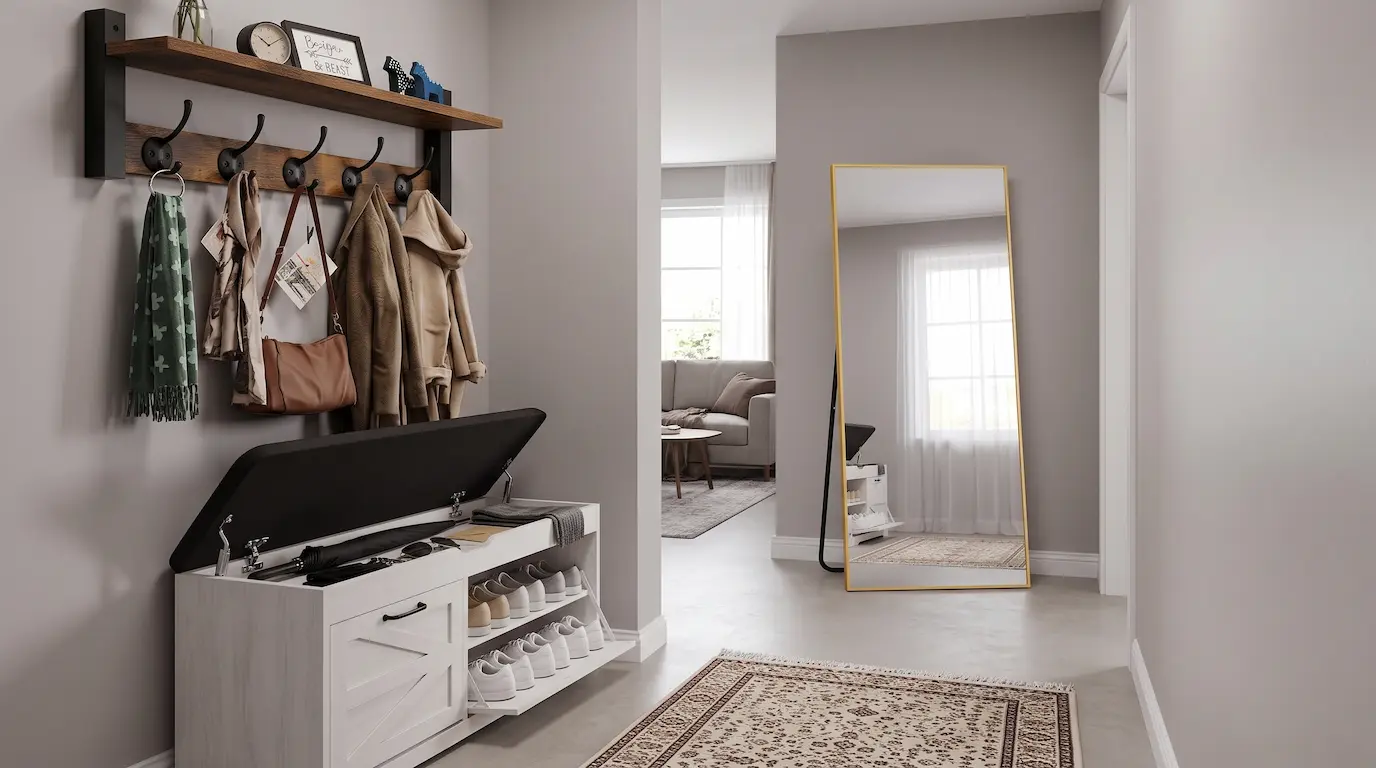
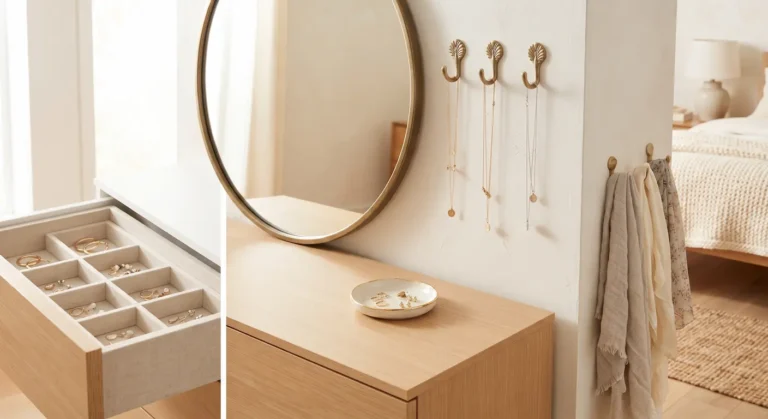
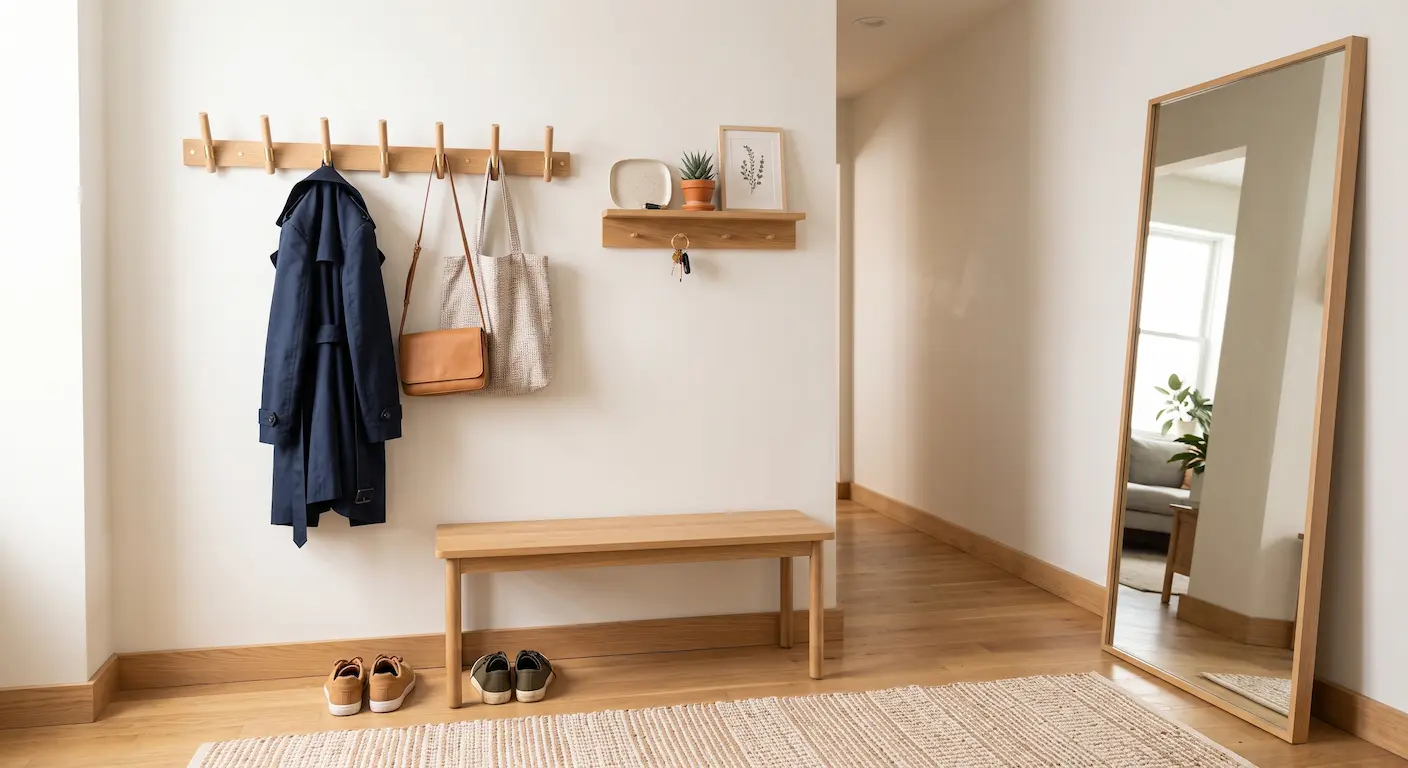
- Hooks on the wall or the door. The cheapest and most effective entryway intervention there is. Three to five hooks at shoulder height take coats, bags and scarves off every other surface in the apartment. Like a rack that combines hooks and a shelf. If you can’t drill, an over-door rack does the same job with zero damage. Like a no-drill over-door rack.
- A narrow bench or stool. You need somewhere to sit to deal with shoes, and if it opens or has a shelf underneath, the shoes live inside it. A bench under 10 inches deep fits corridors most people write off as unusable. Like a 9.4-inch deep storage bench.
- A shallow shelf or console. Six inches of depth is enough for keys, post and a small tray. Anything deeper becomes a dumping ground, which is worse than nothing.
- A mirror. Practical — you check yourself on the way out — and it makes a cramped entry feel twice as wide. In a dark hallway this is the single best visual fix. Like a 65-inch leaning mirror.
- A rug that marks the threshold. A small runner or mat visually separates the entry from the room beyond. This is what does job four, and it costs almost nothing.
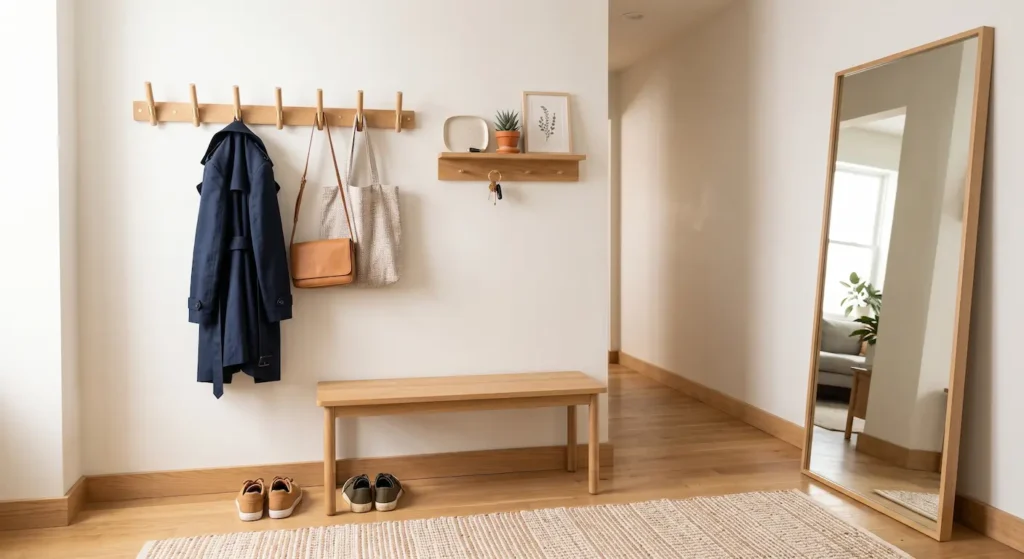
Those five together take up roughly one square metre of floor and about a foot of depth. That’s a real entryway in an apartment that technically has none.
The 18-Inch Entryway
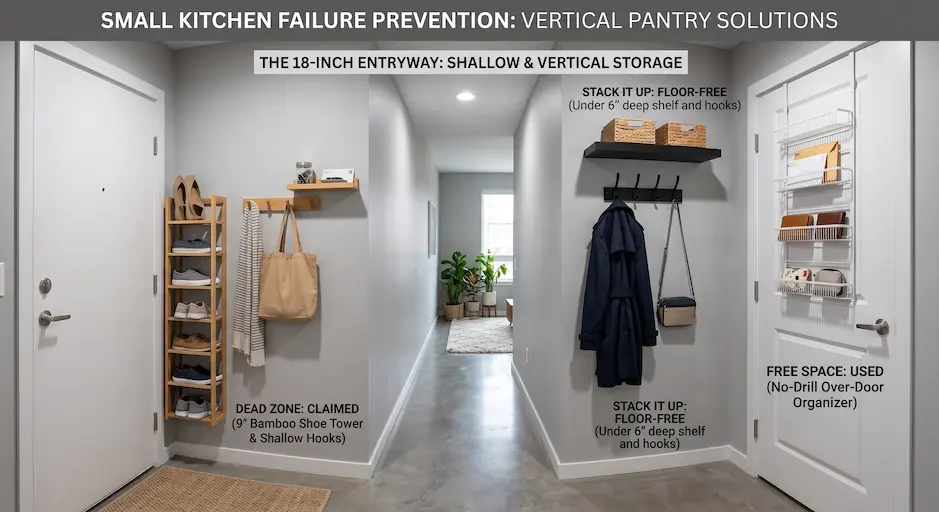
If your door opens straight into a room, you’re working with a strip of wall rather than a space. It still works, you just have to go shallow and vertical.
Stack it up the wall. Hooks at shoulder height, a shelf above them, a basket or two on the shelf. All of it under six inches deep, none of it touching the floor. Ever notice how airports and hotels handle this exact problem with a strip of wall and nothing else?
Use the door itself. The back of a front door holds an over-door rack, hooks, or a slim organiser. It’s completely free space that almost nobody uses.
Claim the wall behind the open door. When a door swings into a room, the wall behind it is dead. A narrow shoe rack or hooks live there perfectly, because nothing else ever needs that space. Like a 9-inch deep bamboo shoe tower.
IMO the strip-of-wall entryway often works better than a proper one, because the shallowness prevents the clutter a deep console invites.
Shoes: The Actual Problem
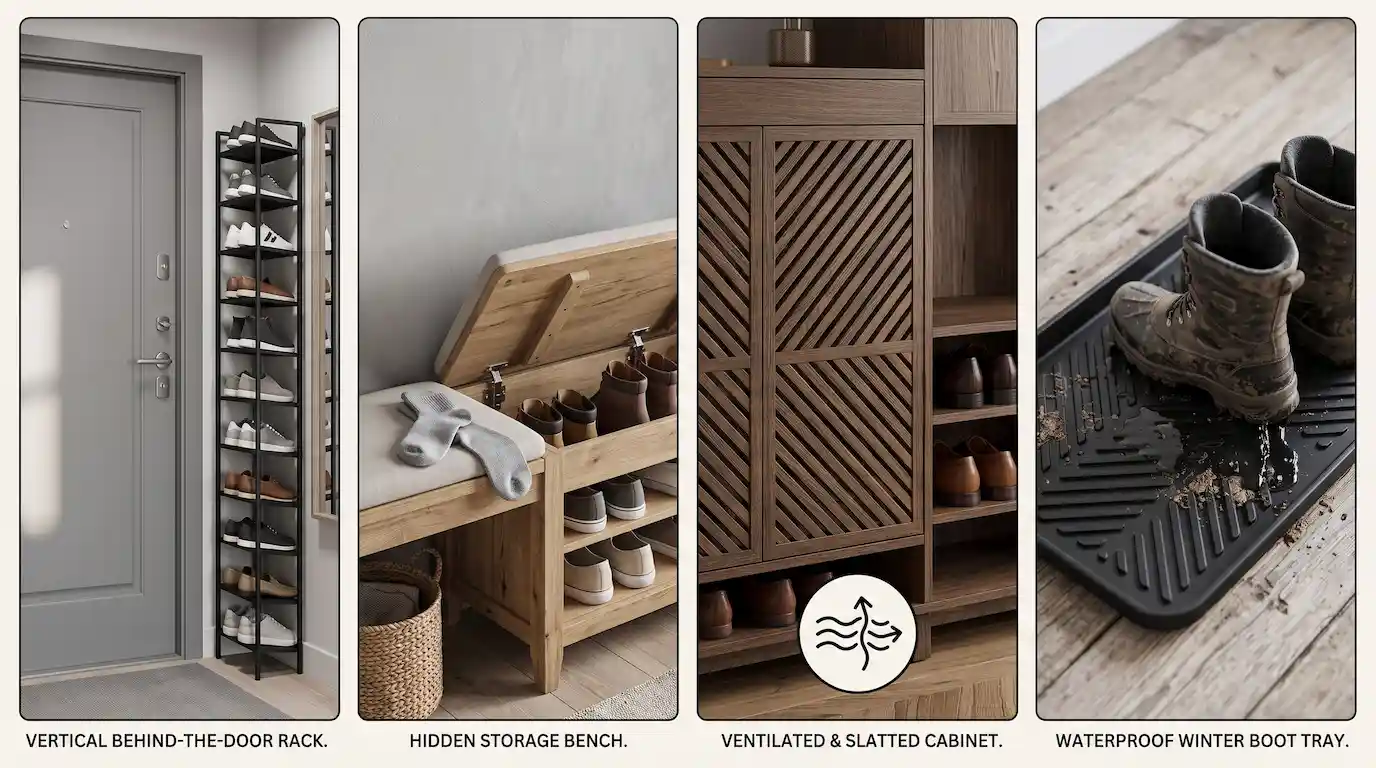
Shoes are what break entryways, because they’re bulky, dirty, numerous and always in motion.
Decide how many pairs live at the door. Two or three each, maximum — the ones in current rotation. Everything else goes in a wardrobe. Most entryway chaos is really a storage-location problem, not a capacity one.
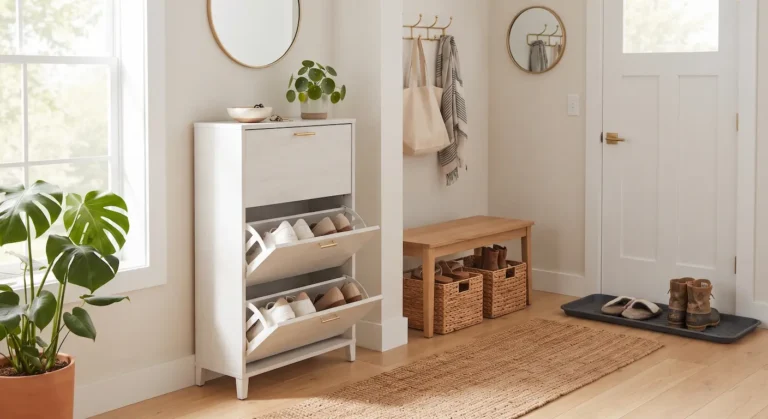
Go vertical or go hidden, not open and horizontal. A flat shoe rack in an open room reads as mess no matter how neatly it’s arranged. A closed bench or a tall narrow rack behind the door reads as furniture.
Ventilate anything enclosed. Closed shoe storage without airflow gets unpleasant fast. Look for slatted or vented designs, and don’t put damp shoes straight in.
Add a boot tray in winter. A shallow waterproof tray contains the mess of wet shoes and protects the floor, which matters more if you rent.
Renting? Nearly All of This Is Damage-Free
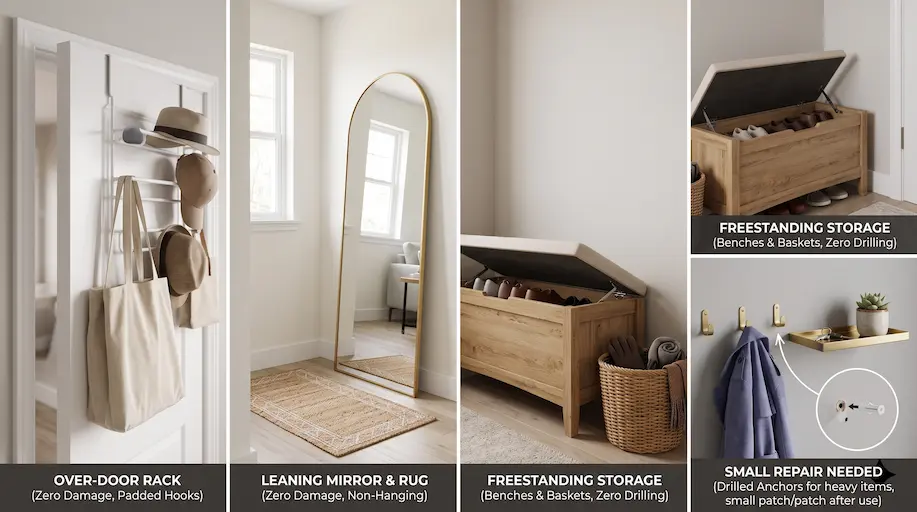
Zero damage: over-door racks and hooks, freestanding benches, shoe racks, baskets, boot trays, rugs, and leaning a mirror rather than hanging it. That covers a complete entryway on its own.
Small holes, easy patch: wall hooks and a floating shelf. Both need anchors if they’ll carry a heavy winter coat — and a coat hook that pulls out of the wall takes a chunk of plaster with it, so don’t rely on adhesive for anything heavy.
One warning: adhesive hooks are the most commonly overloaded product in a home. A wet wool coat plus a bag is heavier than people estimate. Use them for scarves and light bags, and screw in anything that holds a coat.
More on staying deposit-safe in 18 renter-friendly decor ideas.
Winter Makes All of This Harder
Every entryway works in July. The test is January, when the same square metre has to absorb wet coats, boots, umbrellas, hats and gloves — roughly triple the volume, all of it damp.
Plan for the winter load, not the summer one. If your hooks are exactly sufficient in September they will fail in December, and once coats start going on chairs the habit does not come back.
Wet things need somewhere that isn’t the floor. A boot tray for shoes, and ideally hooks with space between them so coats can actually dry rather than pressing together. Coats hung tightly on a crowded rail stay damp for days.
Give gloves and hats a container. A single basket on a shelf handles the small items that otherwise scatter. Without one, they end up in coat pockets and get lost in rotation.
Rotate seasonally. Summer jackets leave the entry in November and come back in April. The entry holds the current season only — same principle as shoes.
Make It Look Intentional, Not Improvised
An entryway assembled from separate purchases tends to read as clutter even when it functions. Three things fix that.
Align things to each other. Hooks in a straight line at one height, shelf directly above or below, mirror centred on the same axis. Misaligned elements are what make a small entry look chaotic.
Repeat one material. Same wood tone or same metal across the hooks, shelf and mirror frame. It costs nothing and does most of the work of looking designed.
Contain the small stuff. One tray for keys, one basket for gloves, one hook per person. Open surfaces accumulate; contained surfaces stay put. FYI this is the same principle that rescues bathroom shelving.
Four Entryway Mistakes
- A console that’s too deep. Anything over about 10 inches becomes a shelf for everything you’re avoiding dealing with. Shallow forces discipline.
- Too few hooks. If there aren’t enough, coats go on chairs. Add more hooks than you think you need — they cost almost nothing and the failure mode is expensive in mess.
- Storing all your shoes at the door. The entry holds the current rotation. Not the collection.
- No landing spot for keys. One small tray or dish solves a problem you have every single day 🙂
One more thing that decides whether any of this survives contact with real life: the entryway has to be faster than the alternative. If hanging a coat takes longer than dropping it on a chair, the chair wins every time. Hooks beat hangers, open trays beat lidded boxes, and a bench you can sit on beats balancing against a wall. Design for the version of you arriving home tired with full hands, not the version tidying on a Sunday.
Start With Hooks and a Tray
If you do two things: put up hooks and put down a small tray for keys. Between them they intercept most of what currently ends up on your sofa, and together they cost about the price of lunch.
Then add somewhere to sit and somewhere for shoes to live. FYI a bench with storage handles both in one object, which is exactly the kind of thing a small apartment should be buying.
If the entry opens straight into a studio, defining that boundary matters even more — seven ways to divide a studio covers it. And there’s more reclaimable space in the 20 spots most apartments waste.
Where does your pile currently form — sofa, chair or floor? Tell me in the comments and I’ll tell you which of the five fixes to do first.
As an Amazon Associate I earn from qualifying purchases. If you buy through a link here, I may earn a small commission at no extra cost to you — it never changes what I recommend.