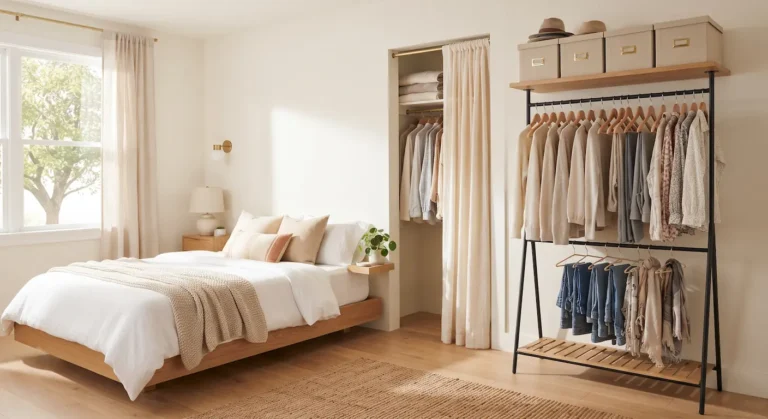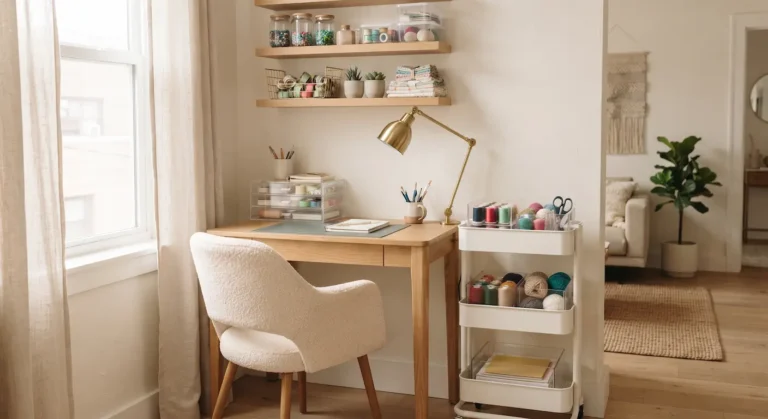
20 Small Apartment Storage Ideas (For Spaces You’re Already Wasting)
You don’t have a storage problem. You have an unused space problem, and they look identical from the couch.
Most small apartments waste the same predictable places: the 18 inches above every door, the void under the bed, the back of every cabinet door, the dead corner behind the bathroom door. Add those up and you’re ignoring more cubic footage than a walk-in closet holds.
Here are 20 spots you already own, grouped by where to look. Start at the top, because that’s where the most space hides.
The Rule: Store Up, Not Out
Floor space is the expensive stuff. Wall and ceiling space is free, and almost nobody uses the top third of a room.
So before you buy a single bin, look up. The band between the top of your furniture and the ceiling is usually 3-4 feet of completely empty volume, running the entire perimeter of your apartment. That’s the single biggest win available to you, and it costs zero floor.
One caveat before we start: storage you can’t reach is storage you won’t use. Keep daily items between knee and shoulder height, and push seasonal things to the extremes.
Measure These Four Things Before You Buy Anything
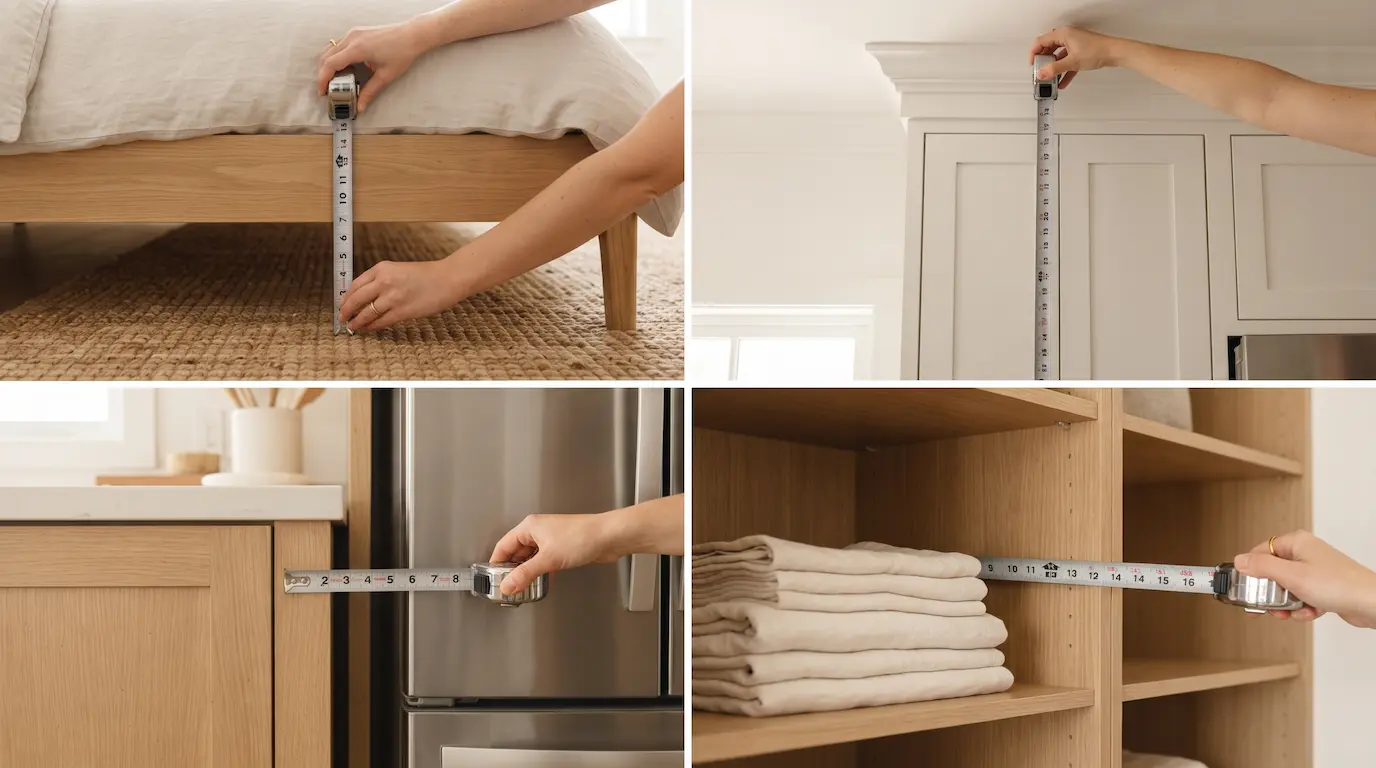
Almost every storage purchase that fails, fails on a measurement. Grab a tape measure and write down four numbers now, because you’ll need all four repeatedly:
- Clearance under your bed and sofa. This decides your bin height, and it varies wildly — anywhere from 3 to 14 inches.
- The gap above your doors and cabinets. Tells you whether a shelf fits and how deep it can be without hitting the door swing.
- Your narrowest dead gap. Beside the fridge, the toilet, the washer. Rolling carts come in specific widths and being an inch off means returning it.
- Shelf depth in your existing closets. Bins that are too deep hide their own contents at the back, which is how you end up buying a third bottle of something you own two of.
Four numbers, five minutes, and it saves you a return trip on roughly every purchase below.
Up High (The Space Everyone Forgets)
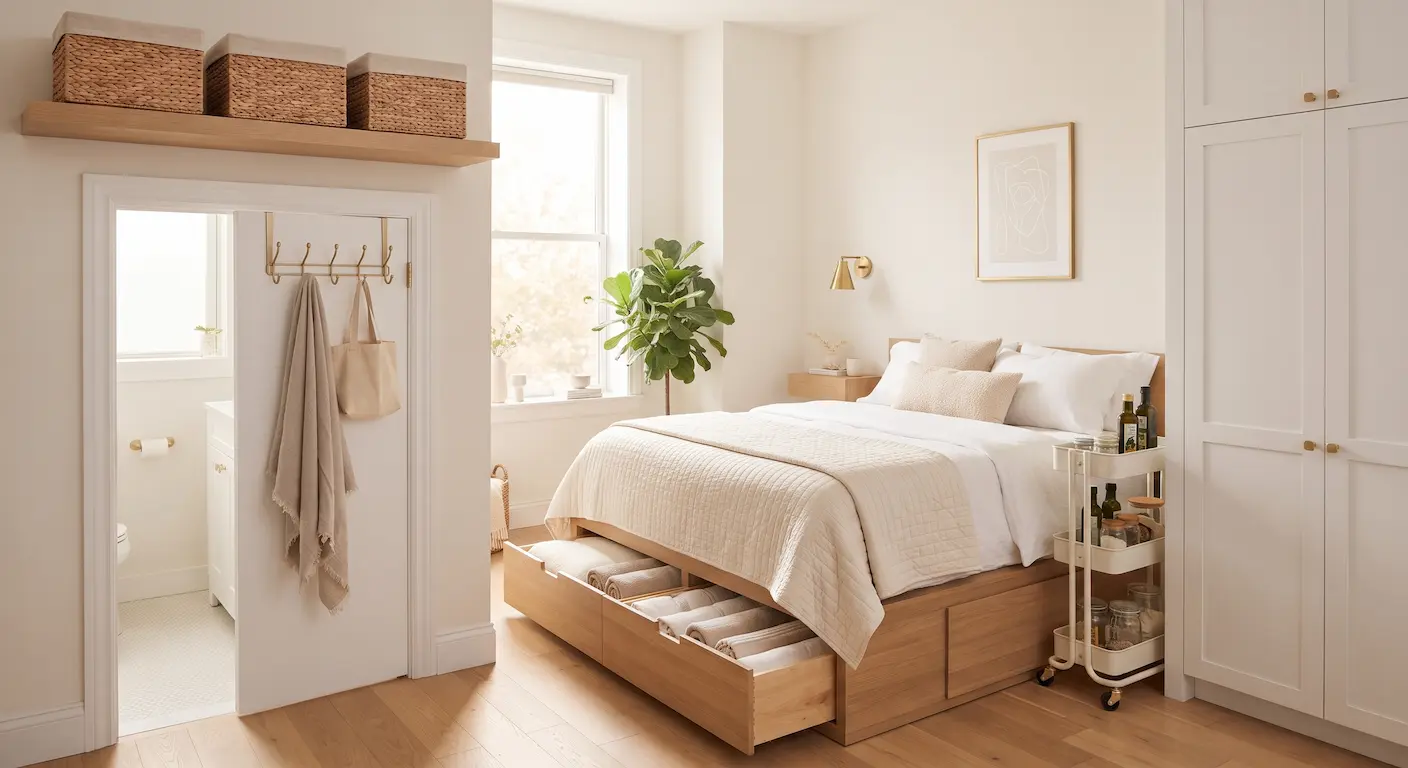
- Above the door frames. Every doorway in your apartment has 12-18 inches of wall above it. A single floating shelf there holds books, baskets or seasonal shoes and reads as intentional, not desperate.
- The top of the kitchen cabinets. If your cabinets stop short of the ceiling, that gap is prime storage. Use matching baskets so it looks styled rather than cluttered.
- A shelf running the room’s perimeter. Install one shelf about a foot below the ceiling along an entire wall. Old libraries do this. It carries an astonishing amount and your eye barely registers it.
- Above the toilet. The most reliably wasted three feet in any apartment. An over-toilet unit or two floating shelves absorbs every bathroom item you own.
Underneath (Free Volume You’re Standing On)
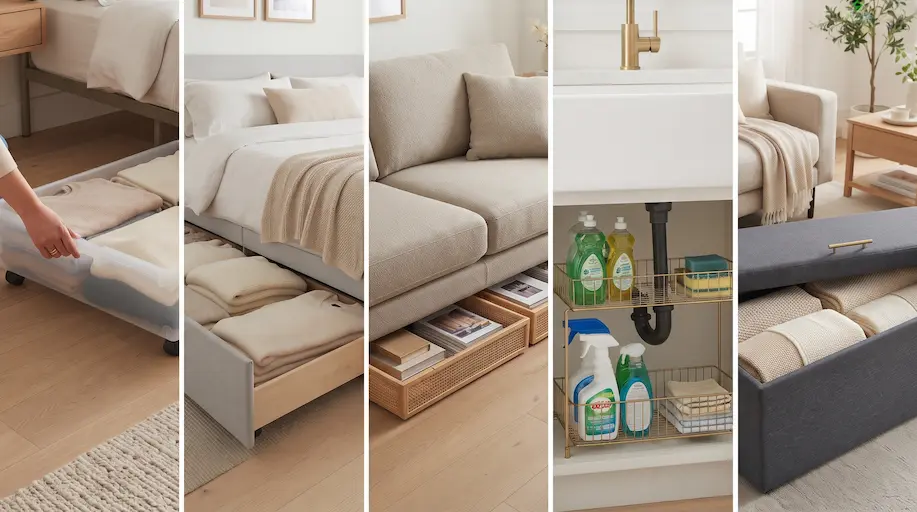
- Under the bed. Obvious, and still wasted by most people because they use it as a junk field instead of a system. Flat wheeled bins beat loose piles every time. More on the bedroom specifically in 15 small bedroom ideas.
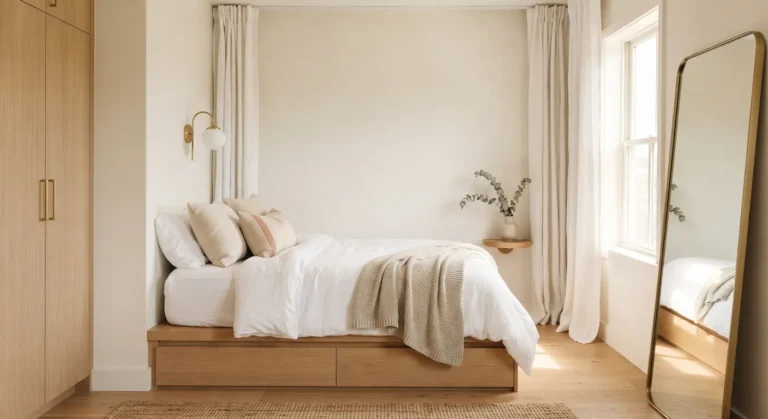
- Inside the bed. A storage platform bed with drawers deletes a whole dresser from your floor plan. Like this one.
- Under the sofa. Most sofas have 4-6 inches of clearance. Slim under-bed bins fit perfectly and nobody ever looks there.
- Under the sink. That cabinet is mostly air wrapped around a pipe. A two-tier expandable shelf that straddles the plumbing roughly doubles it.
- Inside your ottoman. Blankets, controllers, cables. It’s already sitting there doing one job; make it do two. Like a tray-lid version.
Behind Doors (The Flattest Storage There Is)
- The back of every cabinet door. Adhesive or over-hinge racks hold foil, wraps, cleaning sprays and lids — the awkward stuff that never stacks.
- The back of the closet door. Shoes, accessories, or a full hanging organizer. Two inches of depth, enormous capacity. More in small closet organization ideas.
- The back of the front door. Hooks for coats, bags and keys. This is the single cheapest fix on the list and it stops the entryway pile before it starts. Full treatment in entryway ideas for apartments with no entryway.
- Behind the bathroom door. An over-door rack takes towels off whatever surface they’re currently colonizing. Full room treatment in 15 small bathroom storage ideas.
Walls You’re Treating as Decoration
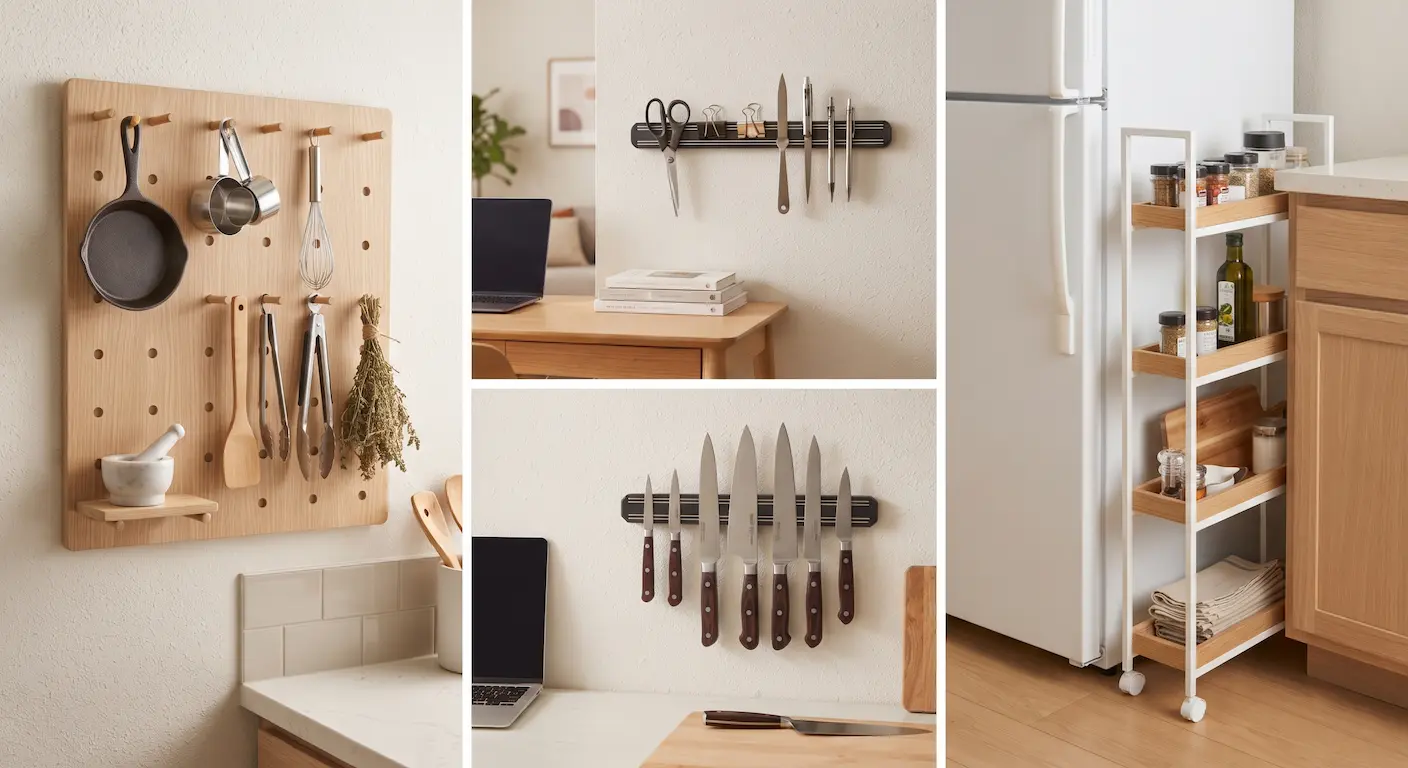 Maximize vertical space: This three-panel composite illustrates three effective wall-storage strategies for small-space living, from a versatile kitchen pegboard and dual-purpose magnetic strips to a narrow rolling shelf for unused gaps.[/caption]
- A pegboard or rail system. Kitchens and desks both benefit. Everything hangs, nothing occupies a surface, and you rearrange it in seconds.
- Magnetic strips. Knives in the kitchen, tools by the desk, bobby pins in the bathroom. Zero footprint.
- Narrow vertical shelving in a dead gap. That 10-inch space beside the fridge or the toilet fits a slim rolling unit almost exactly. Kitchen-specific version in 17 small kitchen storage ideas. IMO this is the most satisfying storage win in any apartment — you gain real capacity out of literal nothing. Like an 11.8″ deep shelf.
Corners and Odd Gaps
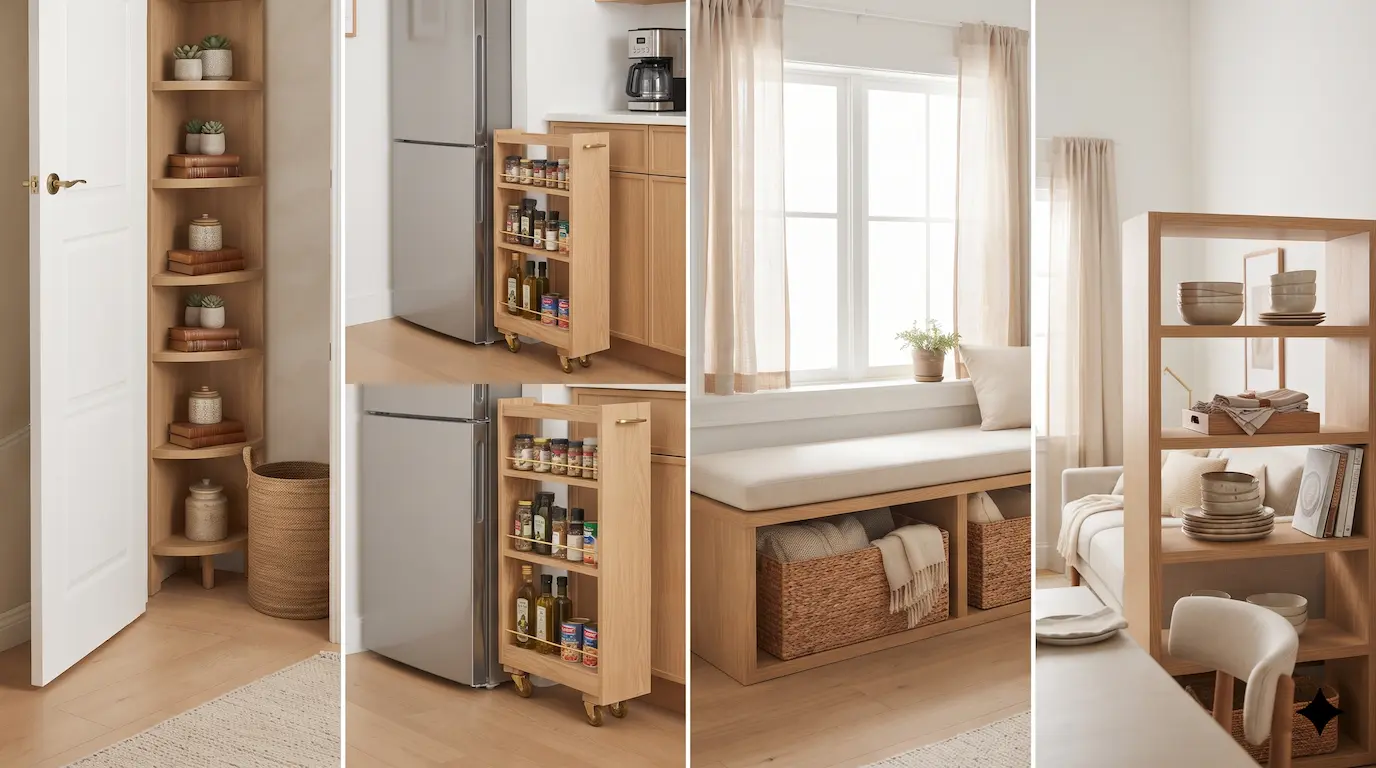
- The corner behind an opened door. Usually dead. A narrow corner shelf or a tall basket works because nothing needs clearance there.
- The gap between the fridge and the wall. A slide-out pantry cart on wheels turns three inches into a spice rack.
- The window sill and the wall beneath it. A low bench under a window gives you seating plus storage and doesn’t block light. FYI this also fixes the “nowhere to sit” problem in one purchase. Like a 9.4″ deep storage bench.
- The back of your open shelving. If you use an open shelf as a room divider, the far side is storage too — it just faces the other zone. More on that in how to divide a studio apartment.
Buy Furniture That Stores Things
The cheapest storage is furniture you were buying anyway. A bed becomes a dresser, an ottoman becomes a chest, a bench becomes a shoe rack — and each one deletes a separate item from your floor plan.
That’s the whole logic behind multifunctional furniture for studios: every piece should store something. If you’re replacing furniture anyway, that’s free storage you never have to find room for.
Renter-Safe: What You Can Install Without Losing Your Deposit
About half this list involves attaching something to a wall, which is where renters usually give up. You don’t have to. Sort the twenty ideas into three buckets and the problem mostly disappears.
Zero damage, install today
Over-door racks, tension rods, magnetic strips, freestanding shelving, under-bed and under-sofa bins, rolling carts, storage furniture, and anything that hangs over a hinge. Roughly two-thirds of the list needs no hardware at all, which surprises most people.
Small holes, easy patch
Floating shelves above doors, pegboards, and perimeter shelving. These need anchors, but the holes are small and spackle costs about three dollars. Most leases tolerate this; most landlords never notice. Photograph the wall before and after anyway.
Ask first
Anything structural, anything that touches cabinetry, and anything requiring more than a few anchors. Built-ins and over-toilet units bolted to the wall land here. The full breakdown lives in 18 renter-friendly decor ideas.
One genuinely useful trick: adhesive mounting strips have gotten good enough for light shelving, but the weight ratings assume perfect application on clean, painted drywall. Halve whatever number is on the box, and never trust them above a bed or a TV.
What’s Worth Buying (And What’s a Waste)
Storage products are a category built on optimism, and a lot of what sells does nothing. After buying plenty of both, here’s my honest split.
Worth it:
- Matching bins in the right size. Uniform containers that fill a shelf edge-to-edge are the difference between storage and a junk drawer with ambitions.
- Clear or labeled fronts. Opaque unlabeled bins become archaeology within a month.
- Anything on wheels. Rolling carts and bins get used because access is easy. Access is the whole game.
- Over-door and over-hinge racks. Cheap, no damage, and they use space that has literally no other purpose.
Usually a waste:
- Vacuum bags. Great in theory. In practice they slowly re-inflate and you end up with the same volume plus a bag.
- Tiny drawer organizers with fixed compartments. They rarely match what you actually own. Adjustable dividers win.
- Anything described as a “system” that requires you to change your habits. If it takes more than one step to put something away, it will not survive a busy week.
Ever notice how the storage products that stick are always the boring ones? There’s a lesson in that.
Three Storage Mistakes That Backfire
- Buying bins before measuring. The most common and most expensive error. Measure the space, then buy containers that fill it edge to edge. Mismatched bins waste 30% of any shelf.
- Storing things where they aren’t used. If you keep coffee filters in the hall closet, you will not put them back. Storage fails on the return trip, not the trip out.
- Making more storage instead of less stuff. Sometimes the answer really is that you own too many mugs. If the room looks cheap rather than cluttered, try 18 budget decor ideas instead. Adding capacity to hold things you don’t use just moves the problem somewhere you can’t see it 🙂
Start With the Ceiling and Work Down
You have far more space than your apartment appears to give you — it’s just distributed in awkward, vertical, easily-ignored slices. Above the doors, under the bed, behind every door, and in the gaps beside appliances. That’s four categories, twenty spots, and none of them cost you a square foot of floor.
Pick the three that annoy you most and fix those first. Don’t do all twenty; you’ll burn out around number six and end up with a pile of empty bins, which is somehow worse than the original mess.
Which spot in your place is the worst offender? Tell me in the comments and I’ll tell you which fix to try.
As an Amazon Associate I earn from qualifying purchases. If you buy through a link here, I may earn a small commission at no extra cost to you — it never changes what I recommend.