15 Small Bedroom Ideas That Make the Room Feel Twice as Big
A small bedroom has one job that a small living room doesn’t: it has to hold a very large rectangle you can’t fold, stack or move. The bed wins the argument before you start.
Which is why most small-bedroom advice fails. “Declutter” and “use light colors” don’t help when the actual problem is that a queen bed eats 60% of your floor and you still need somewhere to put your clothes.
These 15 changes work on the geometry instead. Some cost nothing, some cost a weekend, and the first three matter more than the other twelve combined.
Why Small Bedrooms Feel Smaller Than They Are
Three things drive the feeling, and only one of them is square footage.
Visible floor. Your brain estimates room size largely from how much uninterrupted floor it can see. A room with 40 square feet of clear floor reads bigger than an identical room with the same furniture pushed around badly. This is why leggy furniture beats furniture that sits flat on the ground.
Sight lines. If you can see from the door to the far wall without your eye stopping, the room feels deep. Every tall object in that path chops the room in half.
Vertical dead space. Most small bedrooms use the bottom four feet intensively and the top four feet not at all. That’s half your room doing nothing.
Fix those three and the room grows without losing an inch.
Layout: Where the Bed Goes Decides Everything
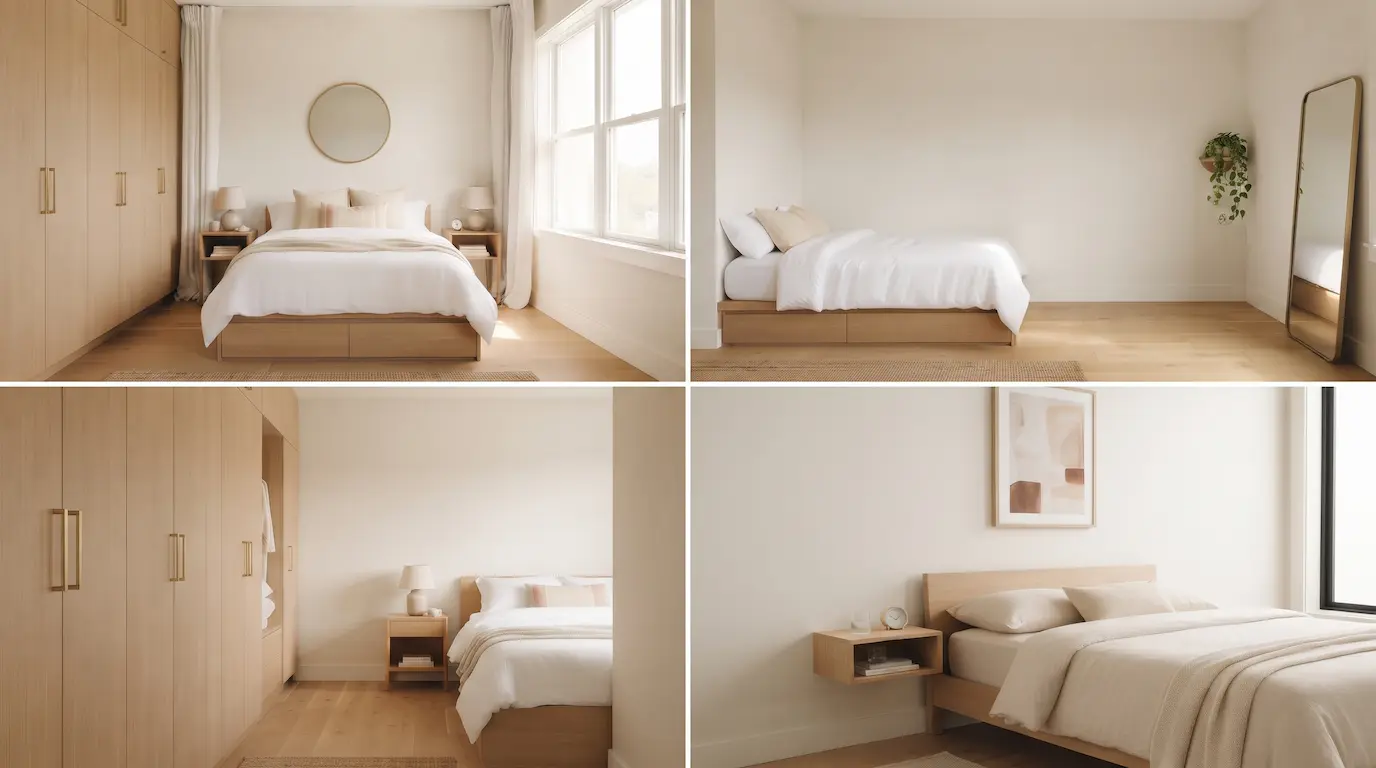
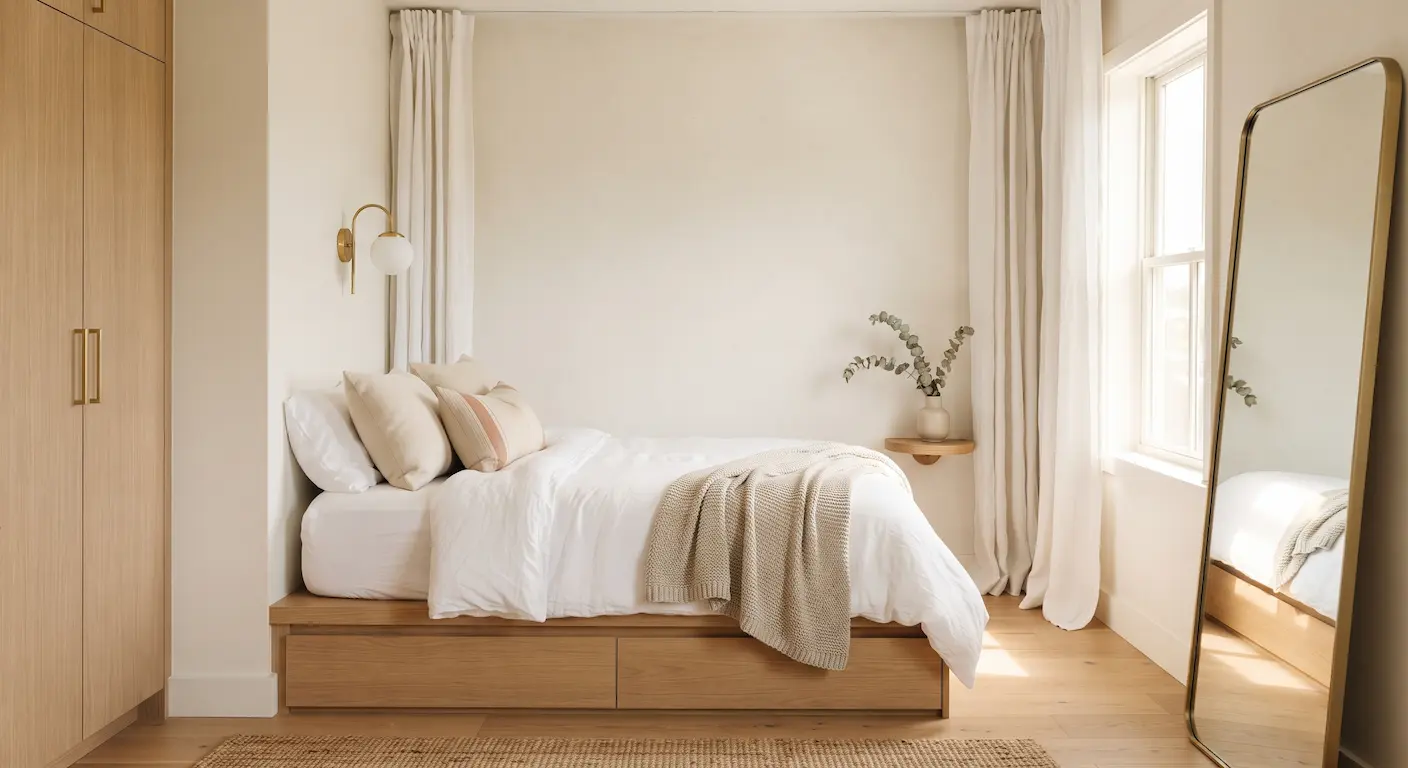
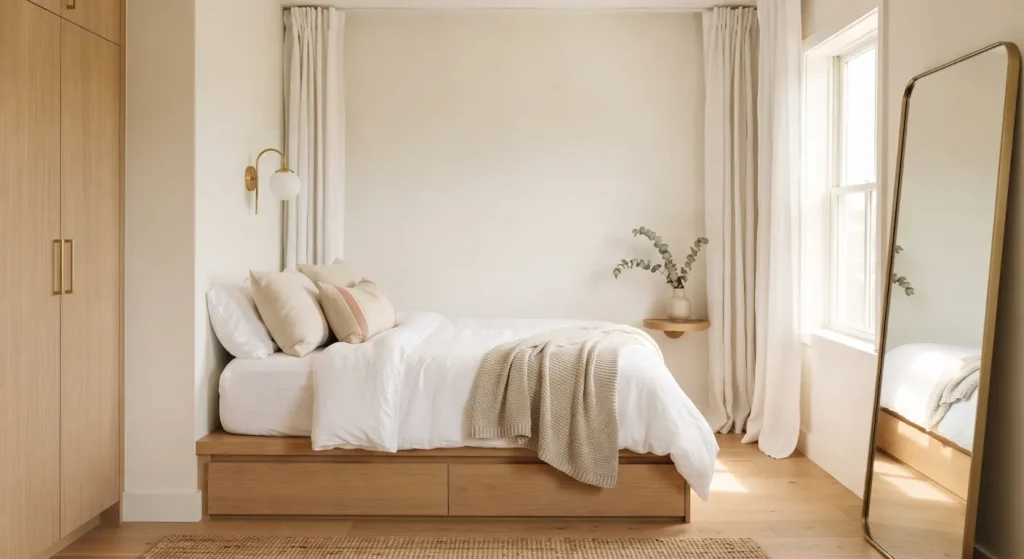
- Center the bed on the longest uninterrupted wall. It feels counterintuitive to give the biggest wall to the biggest object, but symmetry reads as intentional and leaves matched walkways on both sides. If you can only have one thing on this list, have this one.
- Corner the bed only if you sleep alone. Pushing a bed into a corner buys you a genuine chunk of open floor, and it’s the right move in a truly tiny room. But whoever sleeps on the inside has to climb over someone at 3am, and that gets old faster than the extra floor space stays satisfying.
- Protect one clear walkway of at least 24 inches. One generous path beats two cramped ones. A 30-inch walkway on one side and 14 inches on the other feels far better than 22 inches on both, even though the math is identical.
- Kill the second nightstand. Two matching nightstands are a hotel convention, not a rule. Wall-mounted shelves or a single narrow table free up floor on the side you don’t use, and nobody notices the asymmetry once the bed is made.
Visual Tricks That Actually Work
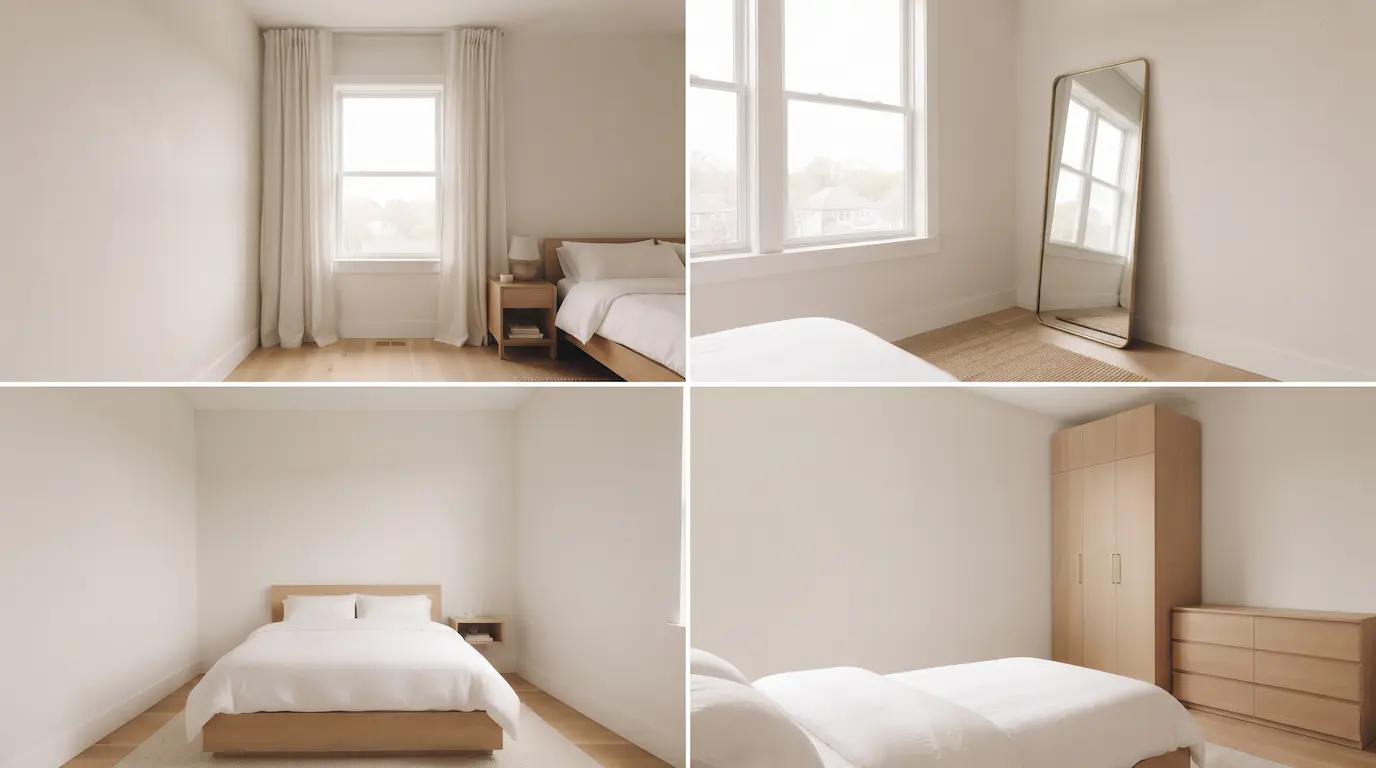
- Hang curtains at the ceiling, not the window frame. Same trick as anywhere else in a small home, and nowhere does it pay off more than a bedroom, where the window is usually small and the walls feel low. Mount the rod 4-6 inches below the ceiling and extend it past the frame on both sides.
- Put a large mirror opposite or adjacent to the window. A mirror facing a window effectively gives the room a second window, doubling your daylight and adding apparent depth. One big mirror works; a gallery of small ones just adds visual noise. Like a 65″ leaning floor mirror.
- Choose a low-profile bed frame. A lower bed leaves more visible wall above it, and visible wall reads as ceiling height. The same room feels noticeably taller with a 10-inch platform than with a tall upholstered headboard.
- Use fewer, larger pieces. Five small items make a room look cluttered; two large ones make it look furnished. IMO this is the most reliably counterintuitive rule in small-space decorating — people instinctively buy small furniture for small rooms and it backfires every time.
Storage That Doesn’t Eat the Room
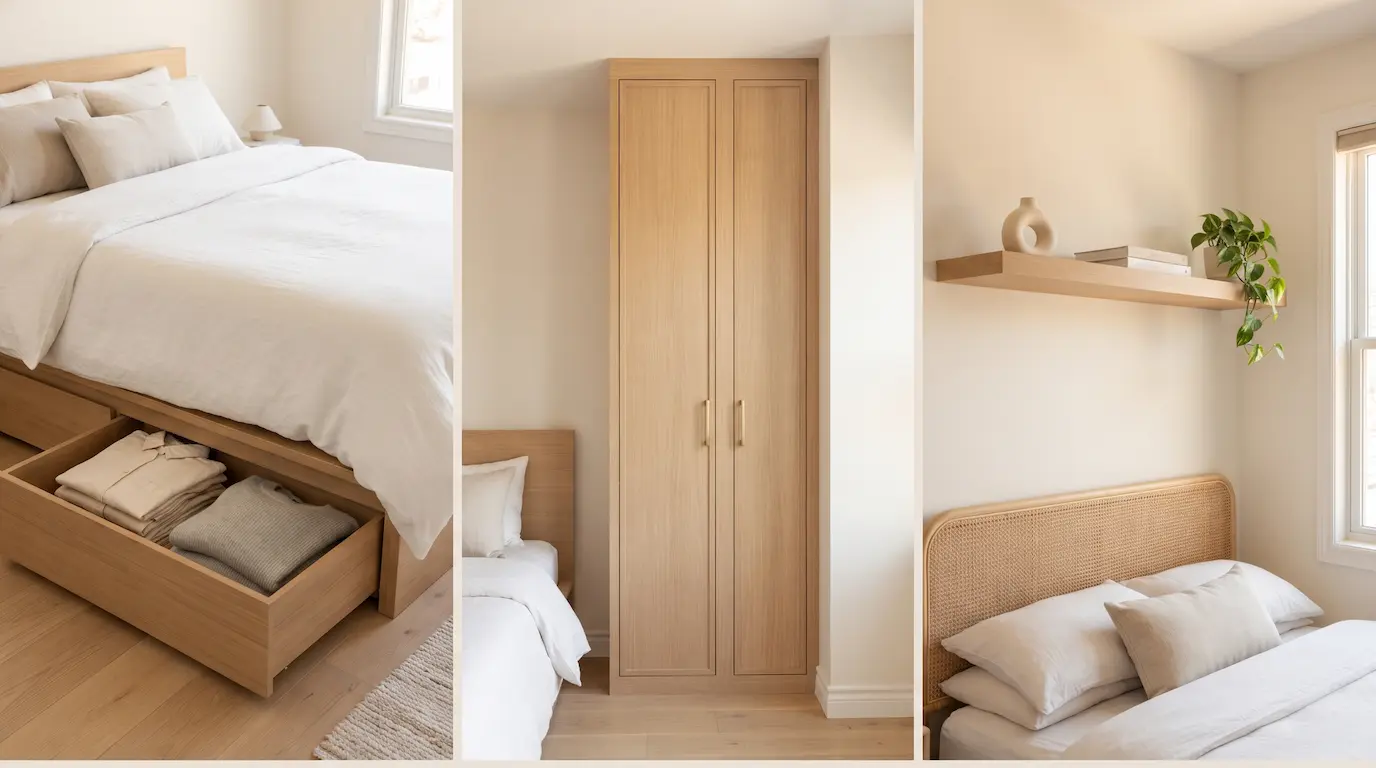
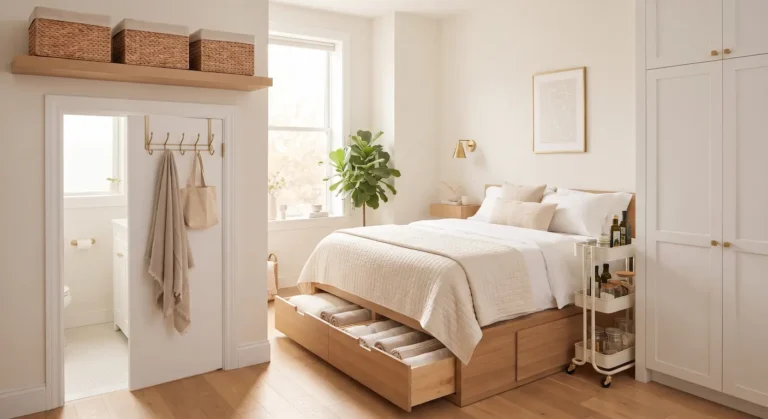
- Store inside the bed. A platform bed with drawers deletes the dresser entirely And if the room has no closet, this covers building storage from nothing., which in a small bedroom is often the difference between a walkable room and an obstacle course. Like this 4-drawer platform bed.
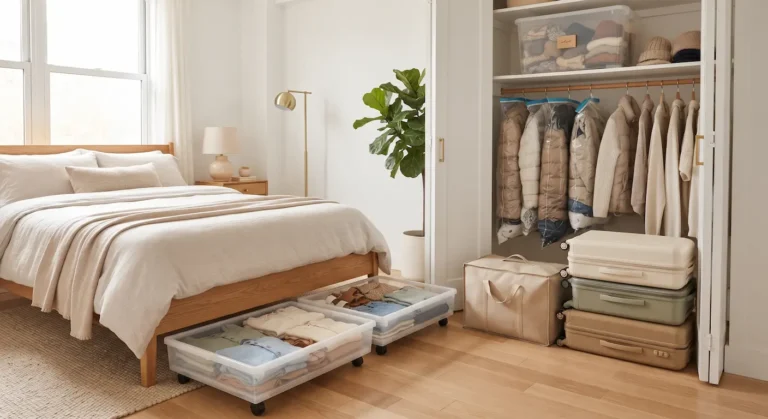
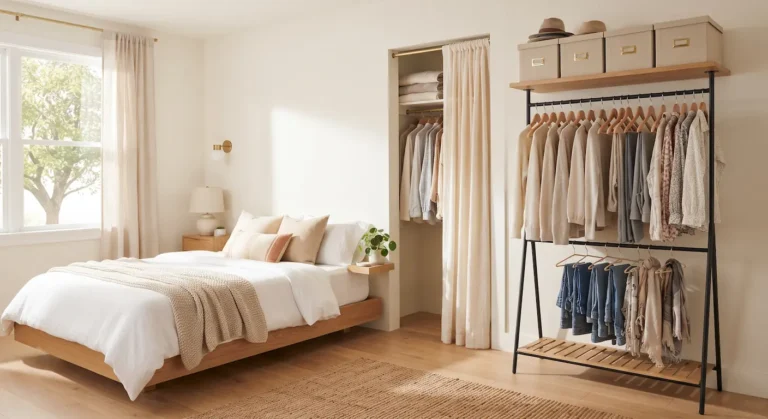
- Build upward, all the way to the ceiling. A tall narrow wardrobe or shelf unit uses the same floor footprint as a short wide one but holds twice as much. Inside the closet itself, a few changes nearly double it. Take it to the ceiling and store the rarely-used things at the top. Like an 11.8″ deep narrow shelf.
- Use the wall above the bed. A single shelf mounted well above the headboard adds storage in a zone nothing else can use. Keep it light, keep it high enough to sit up under, and don’t put anything heavy or breakable directly over a pillow.
If storage is your main constraint rather than layout, there’s a lot more in the 20 spots most small apartments waste.
Light and Color
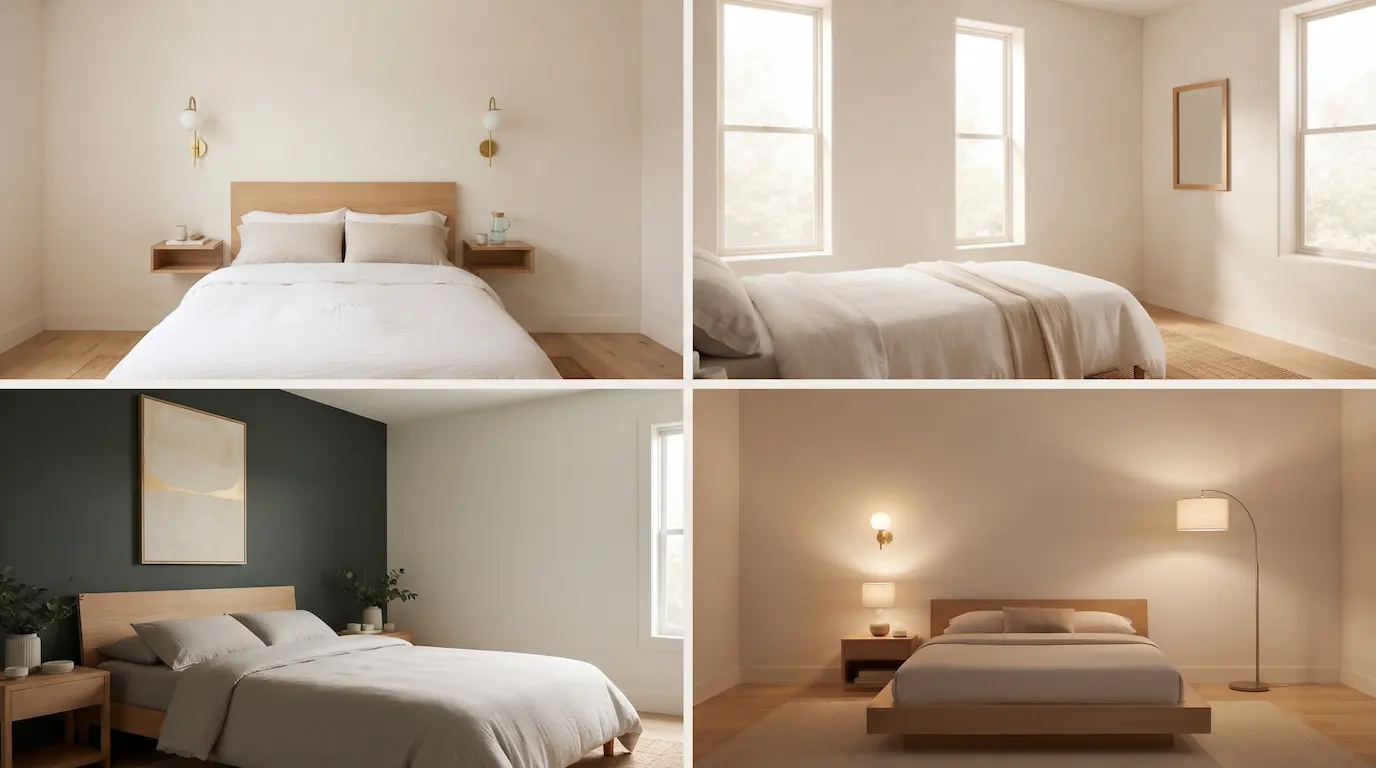
- Get lamps off the surfaces. Wall-mounted or plug-in sconces on either side of the bed free up your entire nightstand and remove two visual obstacles from the room. In a small bedroom, clear horizontal surfaces do more than almost any decor choice. Like this plug-in sconce pair.
- Light walls, but not hospital white. Stark white shows every scuff and can read as cold and flat. A warm off-white or a soft muted tone reflects nearly as much light and looks considered rather than unfinished. Seasonal palettes follow the same logic — see fall decor for small apartments.
- Consider one dark wall. Counterintuitive, but painting the wall behind the bed a deep color makes it recede and adds perceived depth. FYI this works best on the wall you don’t face when you walk in.
- Layer three light sources. Overhead alone flattens a room. Same rule applies next door in the living room. A bedside light, something low and warm, and ideally a lamp near the far corner gives the room dimension after dark, when you’re mostly in it anyway.
Be Honest About Bed Size
Nobody wants to hear this, but the fastest way to fix a cramped bedroom is sometimes a smaller mattress. Here’s the arithmetic people avoid doing.
A queen is 60 inches wide. A full is 54. That six inches sounds trivial — it isn’t, because it comes directly out of your walkway, and walkways are where a room either works or doesn’t. Going from queen to full in a 10-foot-wide room takes a 24-inch path to 27 inches on one side, which is the difference between turning sideways and walking normally.
Rough guidance by room width:
- Under 9 feet wide: a full or a twin, unless the bed goes in a corner.
- 9-10 feet: a queen fits, but you’ll have one usable side and one tight one.
- 10-11 feet: a queen with real walkways on both sides. This is the comfortable minimum for two people.
- Under 11 feet: skip the king. It technically fits in some rooms and it ruins all of them.
Sleep quality matters more than floor space, so if you genuinely need the queen, keep it and corner it. Just make the choice deliberately instead of defaulting to the biggest bed that physically fits.
What Actually Fits: Three Common Room Sizes
Most small bedrooms land in one of three footprints. Here’s what works in each.
8 x 10 feet (80 sq ft)
A full bed centered on the 10-foot wall, one narrow nightstand, and all remaining storage on the walls. Forget a dresser — use a storage bed and a tall shelf. This room lives or dies on vertical storage.
10 x 10 feet (100 sq ft)
A queen centered on one wall with roughly 24 inches each side, two small nightstands or one plus a wall shelf, and a single tall wardrobe. This is the smallest room where a queen and two people work comfortably. Keep everything else off the floor.
10 x 12 feet (120 sq ft)
A queen plus a real dresser, or a queen plus a small chair or desk — but not both. Ever notice how the rooms that feel best are the ones that stopped one piece of furniture earlier than they could have? This is the size where that discipline pays off most.
Four Mistakes That Make a Small Bedroom Worse
- Buying furniture that’s small instead of furniture that fits. A too-small dresser holds too little, so you buy a second one. Now you own two obstacles instead of one useful piece.
- Blocking the window with tall furniture. You’ll gain a wardrobe and lose your light, and light is worth far more per square foot in a small bedroom.
- Filling every wall. Leave at least one wall largely empty. The eye needs somewhere to rest, and an empty wall reads as space rather than absence.
- Putting a rug that’s too small under the bed. A rug that doesn’t extend well past the sides of the bed makes the whole room look undersized. Either go large enough to sit under the nightstands, or run two runners along the sides instead 🙂
Start With the Bed, Then Stop Touching It
Almost every small-bedroom problem traces back to bed placement. Get that right — longest wall, one generous walkway, low profile — and the rest of the decisions get easier, because you’re no longer working around a mistake.
Then do the two cheapest wins: curtains at the ceiling and a large mirror near the window. Those two cost an afternoon and change how the room reads more than any furniture purchase will.
If the bedroom is part of a studio rather than its own room, start with zoning the space first, and if you rent, check what you can safely change in 18 renter-friendly decor ideas.
What’s the actual square footage of your bedroom, and where’s the bed right now? Tell me in the comments — bed placement is usually the fix.