Bedroom Storage Ideas When You Have No Closet
Plenty of bedrooms have no closet at all — older buildings, converted flats, box rooms, studios. You get four walls and a door, and everything you own has to live in furniture you supply yourself.
That’s a harder problem than a small closet, because you’re not optimising storage. You’re building it from nothing, in a room that also has to contain a bed and still look like somewhere you’d want to sleep.
Here’s how to do it without the room turning into a warehouse.
Build the Wardrobe You Don’t Have
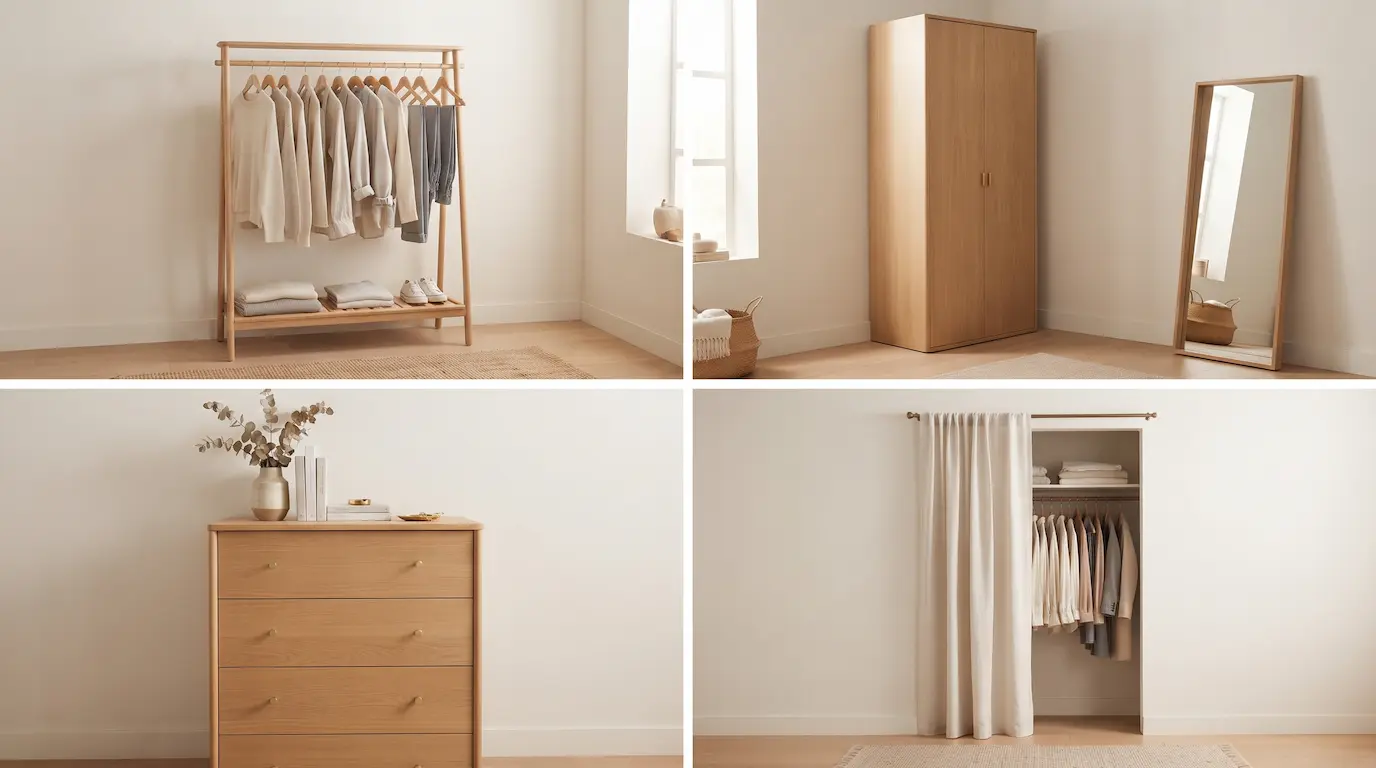
You need hanging space, folded space and shoe space. Most people buy one thing and try to make it do all three.
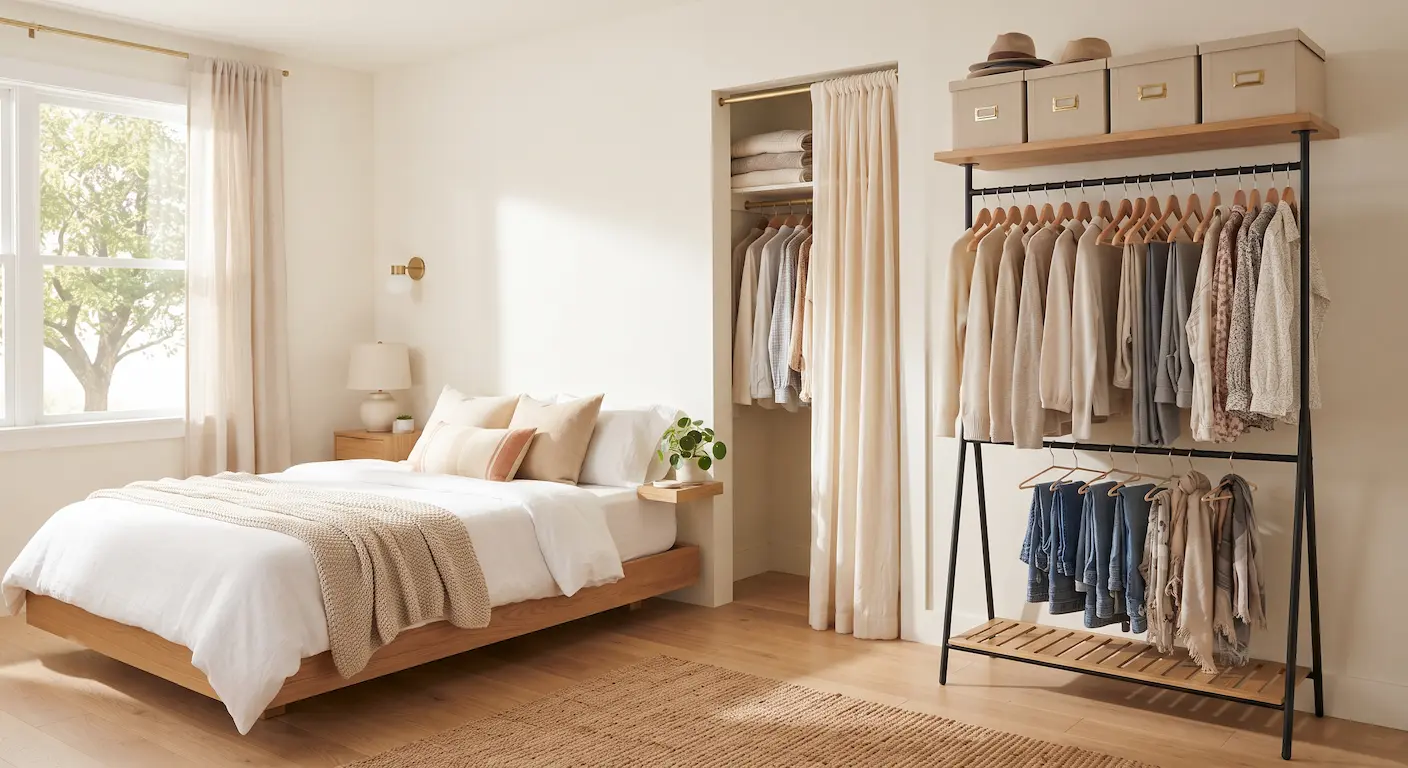
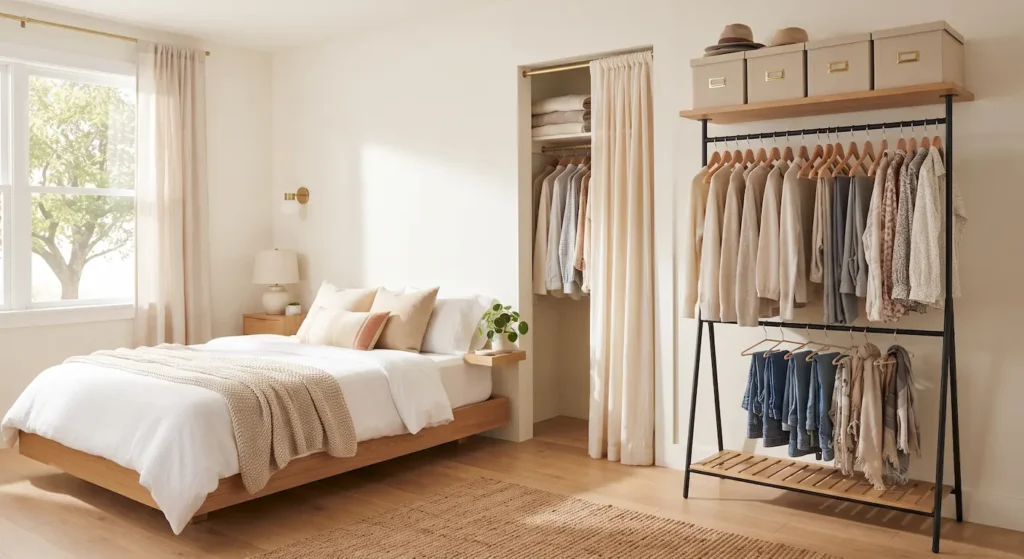
- A garment rack, chosen carefully. The cheapest way to get hanging space, and the most likely to look bad. Get one with a double rod and a shelf, in a finish that isn’t chrome, and it reads as furniture rather than a shop fitting. Keep it full and tidy Like a double-rod rack with a shelf. — a half-empty rack always looks temporary.
- A tall narrow wardrobe or armoire. Better-looking, more expensive, and it hides everything behind a door, which matters enormously when the storage lives in the room you sleep in. Go tall and narrow rather than short and wide.
- A dresser under folded clothes, not on top of them. A three or four-drawer unit handles everything that shouldn’t hang. Place it where its top can double as a surface, since you probably don’t have a dressing table either.
- An alcove with a rod across it. If the room has a recess, a simple rod plus a curtain in front of it makes a closet for very little money. This is the best-value solution when the architecture allows it.
Use the Bed Itself
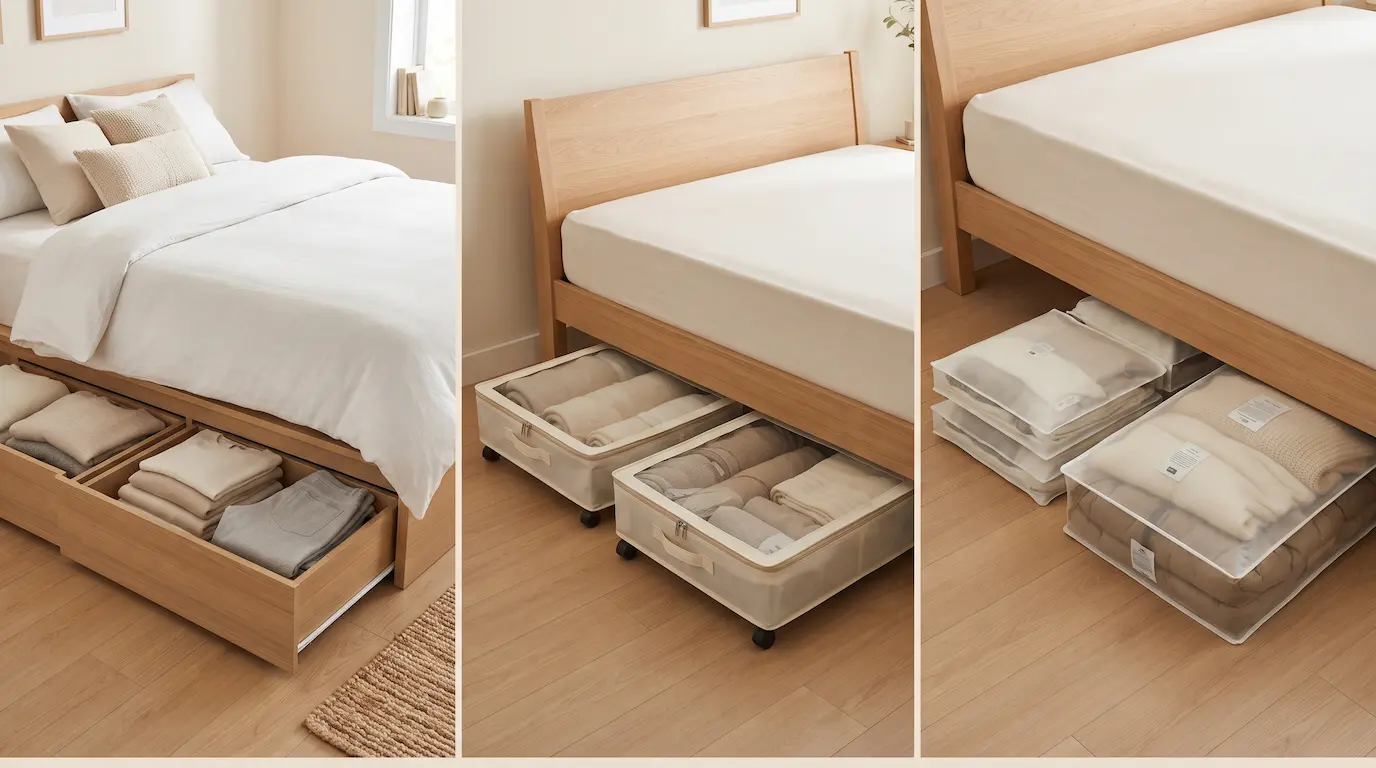
With no closet, the bed stops being just a bed. It’s the largest piece of furniture in the room and it’s sitting on empty volume.
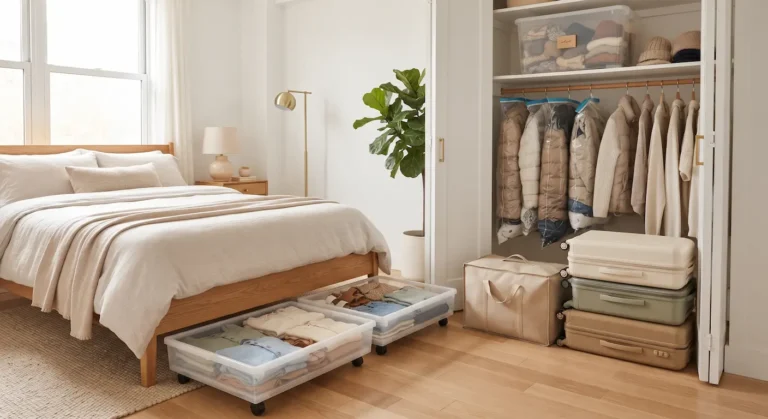
A storage platform bed with drawers. Effectively a built-in dresser, and it removes a whole piece of furniture from a room that can’t afford one. Like a 4-drawer platform bed.
Flat wheeled bins under a standard frame. Cheaper alternative. Measure your clearance first — it varies from 3 to 14 inches and bins are sold in fixed heights.
Vacuum-free compression for off-season. Soft bags under the bed for winter coats and summer linens. FYI plain fabric storage bags work better long term than vacuum bags, which slowly re-inflate.
More under-bed and vertical options in the 20 spots most apartments waste.
Go Up the Walls
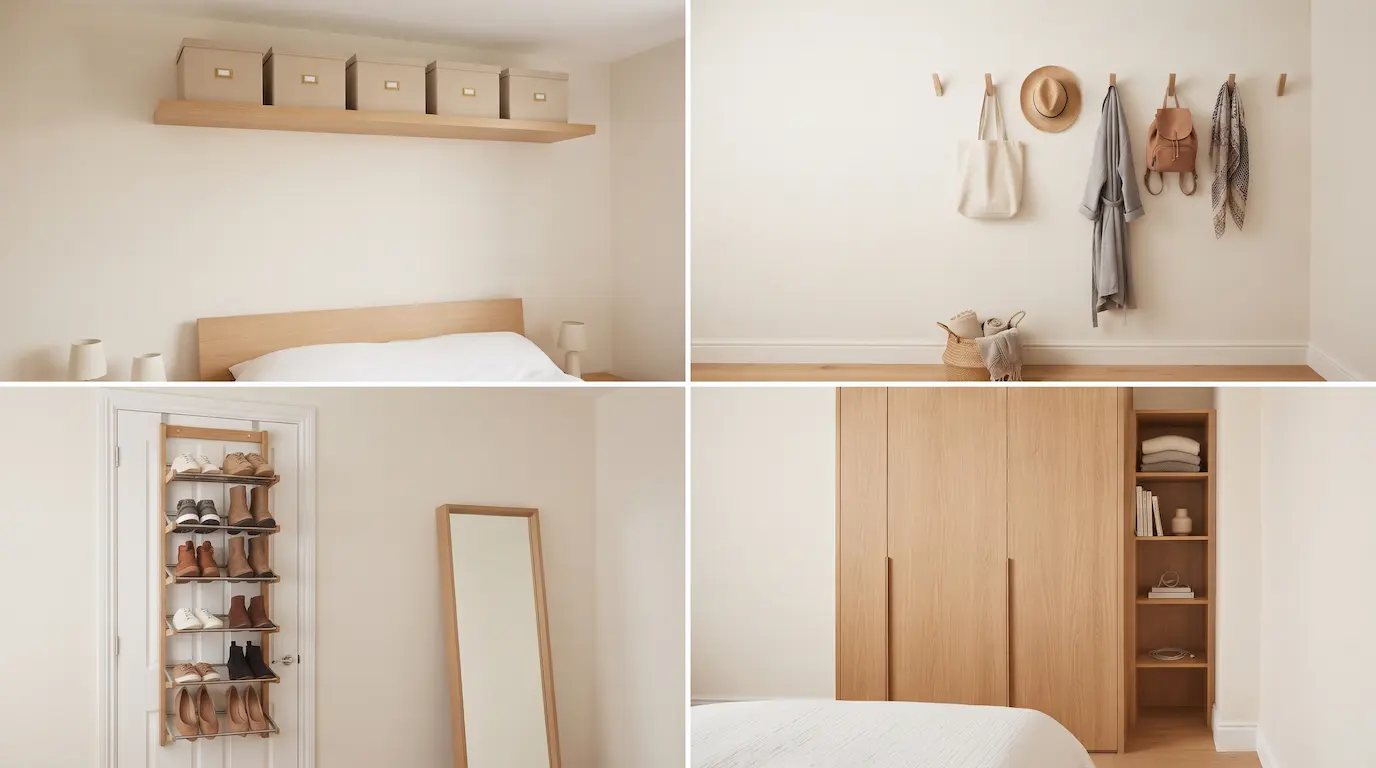
- A shelf high on the wall, all the way around if needed. One shelf about a foot below the ceiling carries boxes of off-season clothing and rarely-used things, in space nothing else can use.
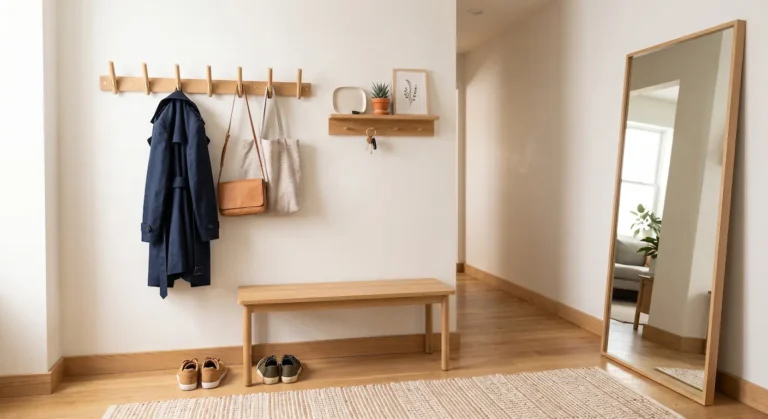
- Hooks and a rail. A row of hooks takes bags, hats, robes and tomorrow’s outfit off the floor and out of the wardrobe. In a closet-less room this replaces the hook on a closet door you don’t have.
- Over-door storage. The bedroom door has two inches of depth behind it doing nothing. Shoes, accessories, or a full hanging organiser. Like a no-drill over-door rack.
- Tall narrow shelving in any dead gap. Beside the wardrobe, beside the bed, behind the door. Ten inches of width becomes a real storage column. Like an 11.8-inch deep shelf.
Making Open Storage Look Deliberate
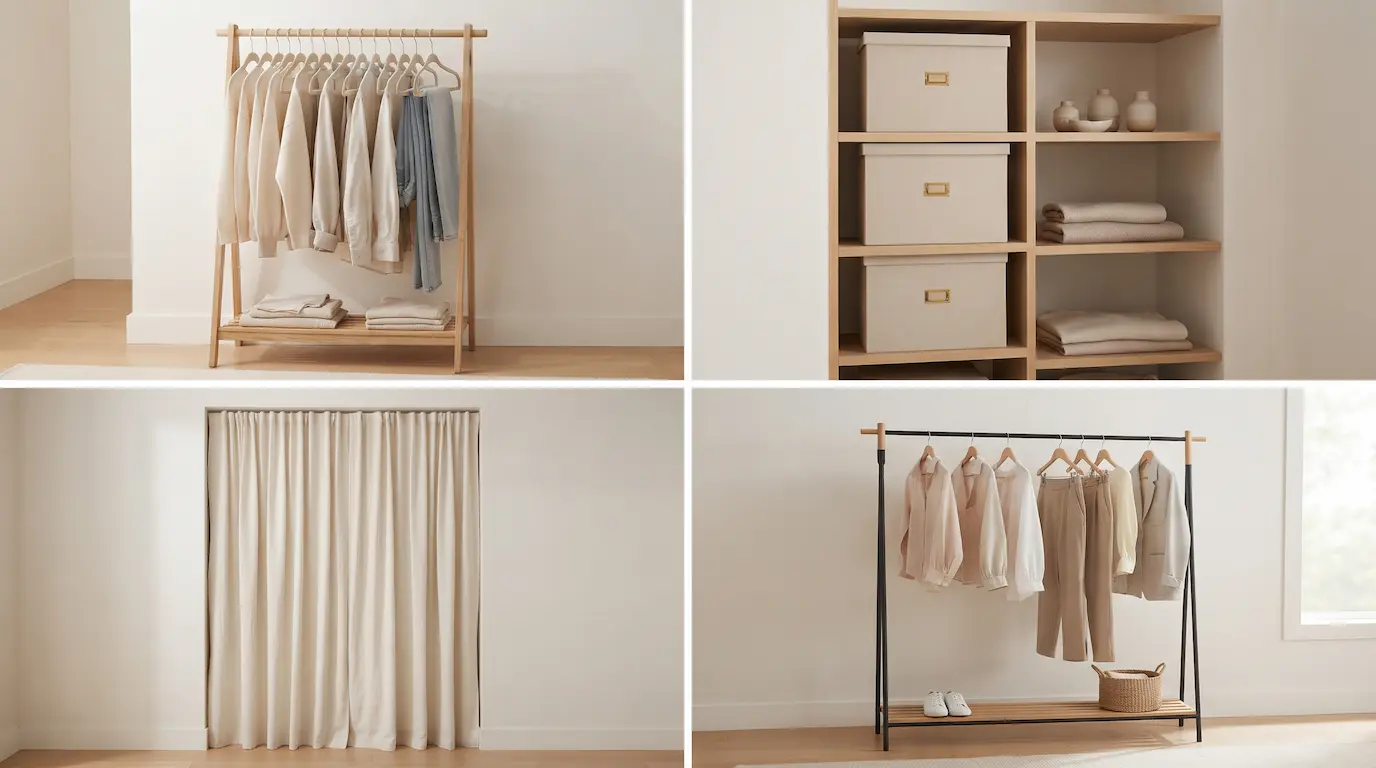
This is the actual challenge. In a room with no closet, your clothes are visible, and visible clothes read as mess unless you handle them.
Uniform hangers, always. Nothing else does as much. Mismatched wire, plastic and wooden hangers is what makes a garment rack look like a jumble sale. Slim velvet ones in a single colour cost little and transform it. Like a 50-pack of slim velvet hangers.
Contain everything that isn’t hanging. Matching boxes and baskets, ideally opaque. Open shelves of folded clothes look messy within a week no matter how well you fold.
Curtain it off. A rail and a curtain across an alcove or in front of a rack hides the whole thing in seconds and costs almost nothing. IMO this is the most underused solution for closet-less bedrooms.
Limit what’s on display. If the storage is open, only current-season clothes belong in it. Everything else goes under the bed or on the high shelf.
Rotate by Season, Not by Habit
Without a closet, a bedroom can only comfortably hold about one season of clothing. Trying to store the whole year in the room is what makes closet-less bedrooms feel chaotic.
Twice a year, swap what’s accessible for what’s stored. Coats and knitwear go under the bed in April; shorts and linen go up on the high shelf in October. It takes an hour and it roughly halves what the room has to display.
How Much Storage Do You Actually Need?
Worth working out before you buy furniture, because closet-less bedrooms usually get either far too little storage or a wardrobe that swallows the room.
Measure your clothes, not your guesses. Push everything you currently own onto one rail and measure how many inches of rail it occupies. That number is your actual hanging requirement, and it is almost always less than people assume — typically 30-50 inches for one person’s current season.
Count the folded volume in drawers, not piles. Three or four drawers handles most people’s t-shirts, knitwear, underwear and sportswear. If you need more than that, the problem is quantity rather than storage.
Then buy for that, plus about 20%. Not double. Storage bought with room to grow gets filled to capacity within a year, and in a closet-less bedroom that capacity is coming directly out of your floor.
Doing this properly usually reveals that a single narrow wardrobe plus under-bed storage is genuinely enough — which is a much better outcome than a rack, a dresser and a set of shelves all competing for the same small room.
If the Bedroom Is Also the Living Room
In a studio the problem compounds, because your clothes are now visible from the sofa as well as the bed.
Closed storage stops being optional. In a separate bedroom you can live with an open rack. In a studio, visible clothing dominates the whole apartment, and a wardrobe with doors or a curtained alcove is worth the extra cost.
Put the clothes storage on the sleeping side of the zone. If you’ve divided the space at all, everything wardrobe-related belongs behind that division rather than in the living half.
Use the divider itself. An open shelf unit acting as a room divider can face storage toward the bed and books toward the sofa — the same object doing two different jobs on its two sides. Seven ways to divide a studio covers setting that up.
Keep the palette quiet. If storage furniture has to be visible in a studio, matching it to the wall colour makes it recede dramatically. Contrast draws the eye to exactly the thing you want people not to look at.
Renting With No Closet
Closet-less rooms are most common in rentals, which is also where you have the least freedom to build one. Two things are worth knowing.
Nearly all of this is freestanding anyway. Garment racks, wardrobes, dressers, under-bed bins, over-door racks and curtained racks need no fixings at all. The only items that do are a wall rail, high shelving and an alcove rod — and an alcove rod is usually a tension fit, so it often needs nothing either.
Buy for the next apartment, not this one. A freestanding wardrobe that fits this alcove exactly is a liability at your next move. Choose things that stand anywhere, break down for transport, and fit through a standard doorway. A closet-less room makes you buy real furniture, and real furniture should outlast the tenancy.
Full detail on what comes off cleanly is in 18 renter-friendly decor ideas.
Four Mistakes in a Closet-Less Bedroom
- Buying a cheap chrome garment rack and leaving it exposed. It’s the fastest way to make a bedroom look unfinished. Either upgrade it or curtain it.
- Short wide furniture instead of tall narrow. Same footprint, half the capacity, and it uses wall you needed.
- Storing all four seasons in the room. The single biggest cause of the problem.
- Open shelving for folded clothes. It looks good for four days 🙂
Hang, Contain, Curtain
Get hanging space first, put everything else in matching containers, then hide whatever’s still visible behind a curtain or a door. That order solves most closet-less bedrooms.
And swap your hangers. It sounds trivial and it’s the change that most reliably makes open clothes storage look intentional rather than improvised — the same principle that runs through small closet organization.
If the room is tight as well as closet-less, 15 small bedroom ideas covers where the furniture should go.
What are you currently using instead of a closet? Tell me in the comments.