Small Dining Area Ideas When You Have No Dining Room
Most apartments built in the last forty years quietly removed the dining room and didn’t tell anyone. You get a kitchen too small to eat in and a living room with no obvious place for a table, so you end up eating on the sofa and telling yourself it’s fine.
It mostly is fine. But there’s a real difference between choosing to eat on the sofa and having no alternative — and a dining spot is one of the few things that makes a small apartment feel like a whole home rather than a room with a bed in it.
Here’s how to fit one, what size to actually buy, and how to make it read as a dining area rather than a table someone abandoned.
Four Ways to Eat in a Small Apartment
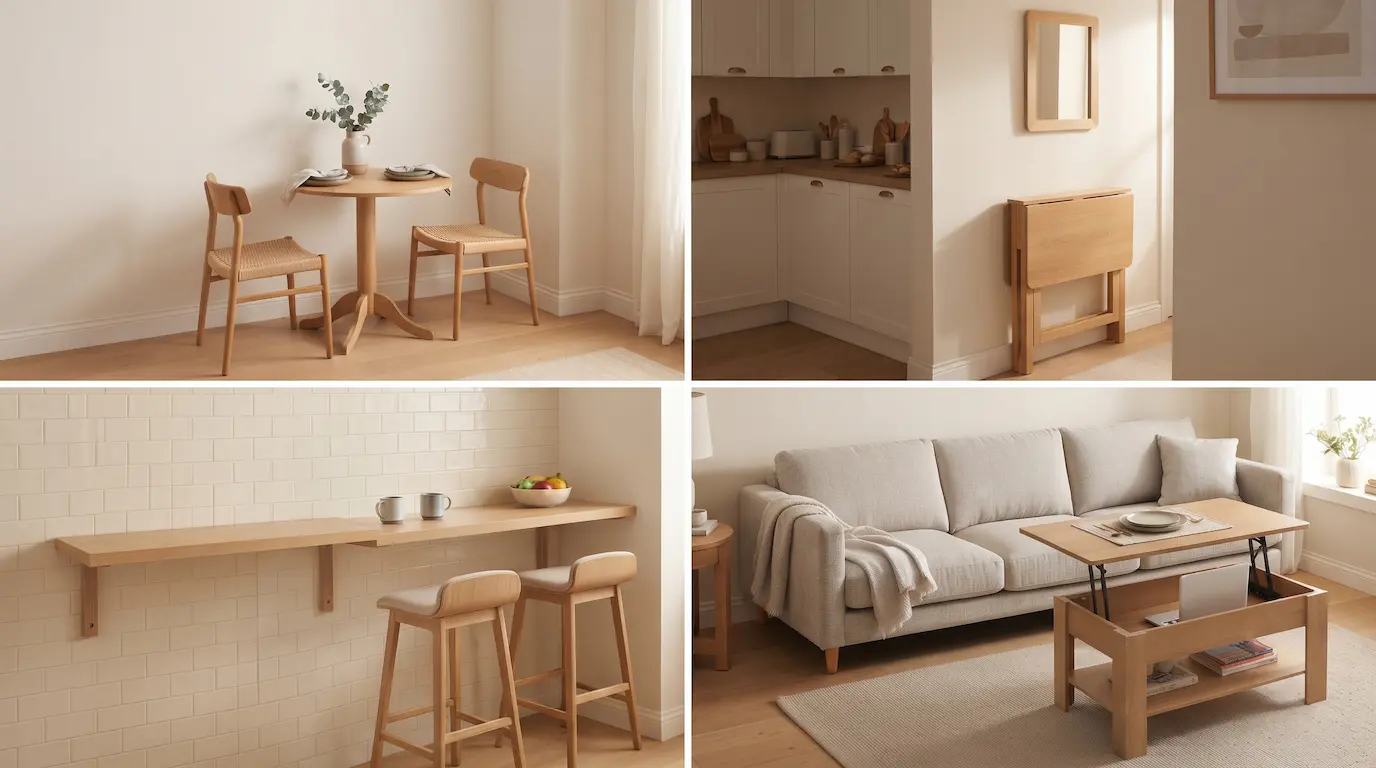
1. A small dedicated table
If you have a corner or a spare bit of wall, a small permanent table is the best option. It’s always ready, it doubles as a desk and a work surface, and it gives the apartment a proper second zone.
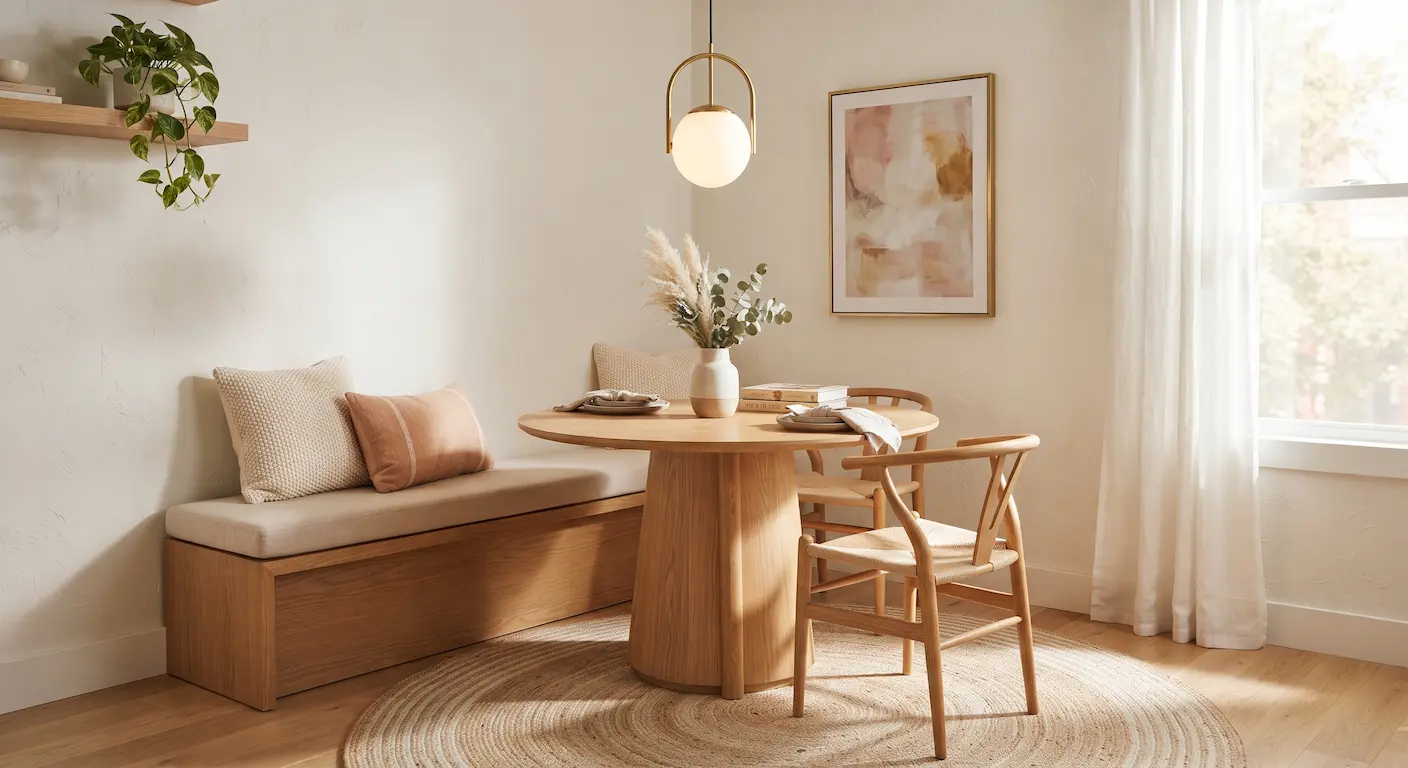
A 30-inch round seats two comfortably and four at a squeeze. That’s a footprint smaller than most armchairs. Like a 30-inch round pedestal.
2. A drop-leaf or folding table
The classic answer. Sits against the wall as a narrow console most days, unfolds when you need it. Some collapse to under 13 inches deep, which is genuinely nothing. Like a drop-leaf that folds to 13 inches.
Best if you eat at a table occasionally rather than daily — the folding gets tedious if it’s every night.
3. A counter or breakfast bar
If you have any counter overhang, or room for a narrow bar-height table against a wall, two stools turn it into a dining spot. Bar stools tuck fully underneath, which floor-standing chairs never quite do.
4. A lift-top coffee table
The studio answer. It raises to a comfortable eating height in front of the sofa, then drops back down. Not a formal dining setup, but it’s a genuine improvement over a plate on your knees, and it costs you zero additional floor space. Like a lift-top coffee table.
Table Size: The Arithmetic Nobody Does
Most small dining failures are a measurement problem, not a space problem.
You need 24 inches of table width per person. Less than that and elbows collide. So a table for four needs roughly 48 inches of usable perimeter, which a 36-inch round or a 48×30 rectangle both provide.
You need 36 inches of clearance to pull a chair out and sit down. This is the number people ignore, and it matters more than the table itself. A table that fits the room but leaves 20 inches behind the chairs is unusable.
If clearance is tight on one side, push the table against the wall. Three usable sides and one against the wall works fine, and it recovers the clearance you don’t have.
Round beats rectangular in tight rooms. No corners to walk into, easier to squeeze an extra person around, and it reads as smaller than a rectangle of the same capacity. IMO a round pedestal table is the single best choice for a small apartment, because the central base means no legs interfering with chairs.
Seating That Doesn’t Eat the Room
- A bench on one side. Pushes fully under the table when not in use, seats two or three, and disappears visually because it has no back. This is the highest-value seating decision in a small dining area.
- Stackable or folding chairs for guests. Two everyday chairs plus two that live in a closet beats four chairs permanently occupying the room.
- Chairs without arms. Armless chairs tuck further under the table, which can recover six inches of walkway on each side.
- Use furniture you already own. A storage ottoman or a small stool works as an extra seat when people come over, and does something else the rest of the time. Like a storage ottoman.
The rule: everyday seating should tuck fully under, and guest seating should live somewhere else.
Make It Read as a Dining Area
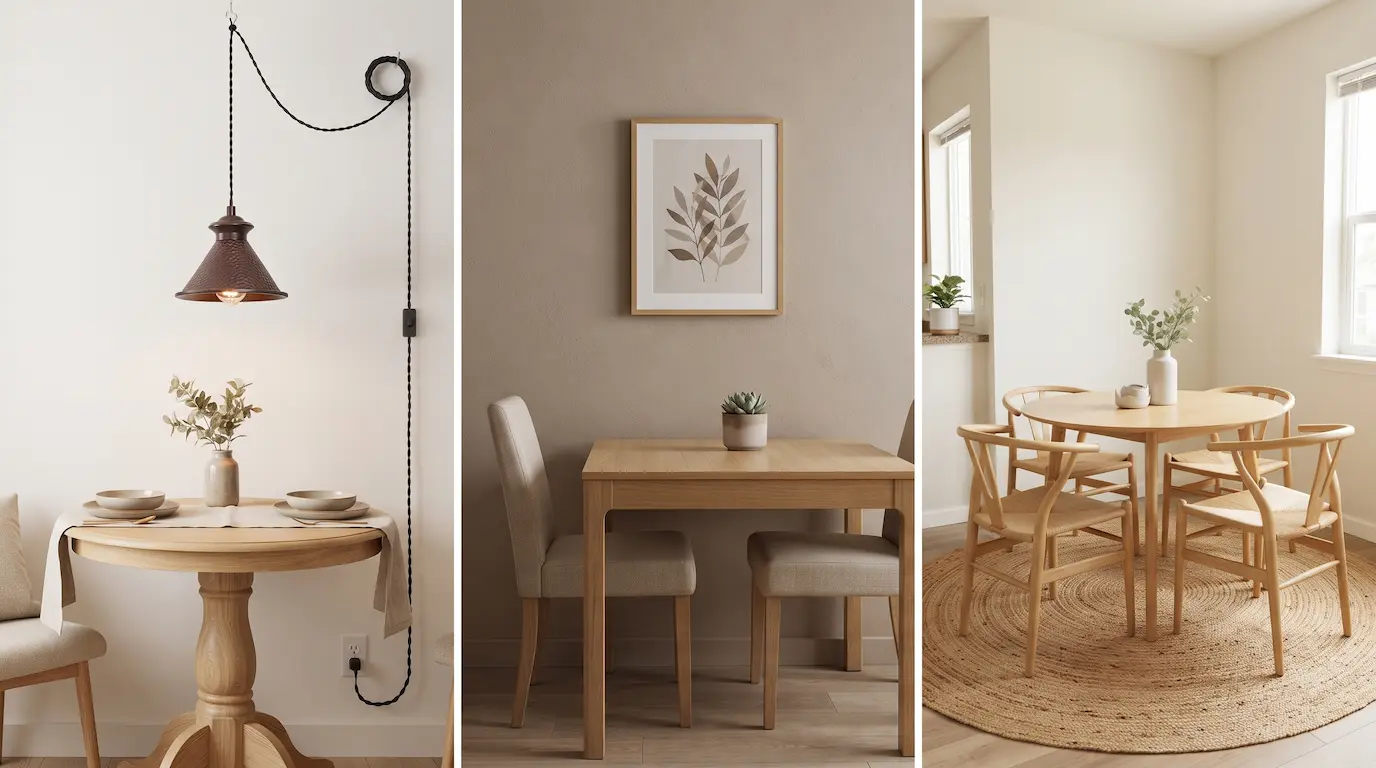
A table in the corner of a living room can look like furniture in transit. Three cheap things fix that.
Hang a light over it. Nothing defines a dining zone faster than a pendant directly above the table. If you can’t wire one, a plug-in pendant on a hook does the same job with a cord. Like a 16ft cord-and-hook kit.
Put art on the wall beside it. One piece at the table’s eye level tells your brain this is a place, not a leftover corner.
Anchor it with a rug — carefully. A rug defines the zone, but it must extend far enough that chairs stay on it when pulled out. A rug the chairs catch on is worse than no rug at all.
FYI these three cost less than the table and matter more for whether the space feels intentional. There’s more on zoning in seven ways to divide a studio.
If You Genuinely Have No Room for a Table
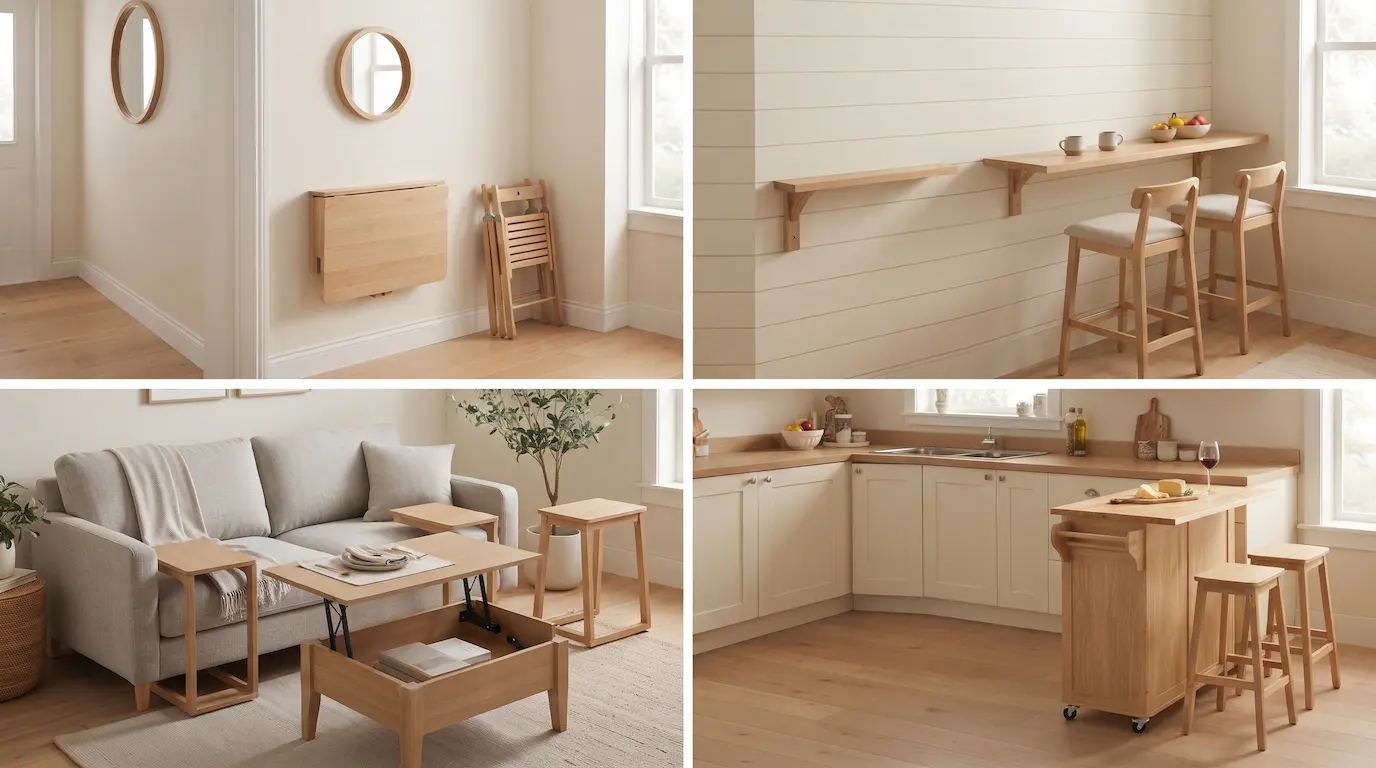
Some apartments really don’t have space, and the honest answer is not to force one in. A table that blocks a walkway costs you more every day than it gives you at dinner.
A wall-mounted drop-leaf. Folds to two or three inches of depth and mounts at any height. It’s the only true zero-footprint dining surface, and it works in a hallway or beside a kitchen door.
A narrow bar-height ledge. A 10-inch deep shelf at 40 inches high, with two stools, gives you a real eating spot along a wall that couldn’t hold a table.
Improve the sofa version instead. If you’re going to eat on the sofa anyway, make it deliberate: a lift-top coffee table at proper height, or a pair of C-shaped side tables that slide over the seat. That’s a genuine upgrade over a plate balanced on a cushion, and it costs no floor at all.
Use the kitchen counter properly. If there’s any overhang, two stools convert it. If there isn’t, a rolling cart parked against the counter creates one and moves away afterwards.
Renting? Take the Dining Setup With You
Nearly all of this moves with you, which matters when the next apartment has a different shape.
Buy round or small over built-in. A 30-inch round table fits almost any apartment you’ll ever live in. A large rectangular table fits one specific room and becomes a problem at every move.
Check it breaks down. Tables with removable legs and benches that flat-pack survive moves. Solid one-piece furniture is how people end up leaving things behind.
Plug-in pendants over hardwired ones. A cord-and-hook pendant gives you the defining light over the table with two small ceiling hooks instead of an electrician, and it unhooks in a minute.
Wall-mounted anything needs permission. Drop-leaf tables and bar ledges carry real weight and need proper fixings. Worth asking rather than assuming — what comes off cleanly covers the rest.
One more thing worth knowing: a dining spot gets used in proportion to how little effort it takes. If eating at the table means unfolding it, finding chairs and clearing a surface, you will eat on the sofa. Every extra step halves the odds, which is the real argument for a small permanent table over a larger folding one.
Four Small Dining Mistakes
- Buying a table sized for the room instead of the clearance. The table fits, the chairs don’t move. Measure the pull-out space first.
- Four permanent chairs for two people. Two chairs and two stored ones give you the same capacity and a bigger room 360 days a year.
- A rectangular table in a narrow room. It creates two corridors instead of one, and the corners catch every hip that passes.
- Letting it become a desk permanently. A dining table that’s always covered in laptops and post stops being a dining table, and the sofa wins again 🙂
One habit that decides whether the dining spot survives: clear it completely after every meal. Small-apartment tables die by accumulation — post, keys, a laptop, a charger — and once the surface is 60% covered nobody eats there again. It takes ninety seconds and it is the difference between owning a dining area and owning a table that collects things.
Measure the Clearance, Then Buy Round
If you take one thing: measure 36 inches out from where the table edge will sit, on every side you’ll actually use. If that fits, buy the table. If it doesn’t, go smaller, go round, or push it against a wall.
Then a bench on one side and a light above it, and you have a dining area in an apartment that was never designed to have one.
If the space is shared with your living room, four layouts that actually work covers how to fit both, and multifunctional furniture covers the pieces that do double duty.
Where do you eat right now — sofa, counter, or a table that’s really a desk? Tell me in the comments.